
Shaker cabinets are still in style in 2026, and they’re still the cabinet door homeowners choose more than any other. In the most recent national data, 58% of homeowners selecting new or upgraded cabinets picked shaker, compared with 22% for flat-panel, according to the 2026 Houzz Kitchen Trends Study. The headlines announcing that a new style is replacing shaker are describing changes happening within shaker itself: slimmer frames, warmer color, quieter hardware. Not a move away from it.
At Boss Design Center, we’ve designed kitchens across Northern Virginia, Maryland, and D.C. since 2014, and shaker is one of the cabinet profiles we install most often. We build it in the contemporary colors and two-tone finishes that define a current kitchen, and we’ll tell you plainly where shaker is the right call and where it isn’t. The answer most trend pieces skip: whether shaker is worth it depends far more on how the cabinet is built and how the whole room is composed around it than on the door profile itself.
What makes a cabinet a shaker cabinet?
A shaker cabinet door is a five-piece door: two vertical stiles, two horizontal rails, and a single recessed flat center panel framed by them. The look comes from the Shakers, a 19th-century religious community whose furniture prized function and clean lines over ornamentation. That’s the whole history you need. What matters for your kitchen is the result: a square, unfussy frame around a flat panel, with no raised molding, beading, or carved detail.
That simplicity is exactly why shaker has lasted. It reads as traditional in a wood tone, transitional in a soft painted finish, and nearly modern in a slim white profile. One door shape covers a wide range of kitchens, which is the main reason it keeps winning.
Are shaker cabinets still in style in 2026?
Yes. Shaker is the most-installed cabinet door style in the country, and the broader design direction still favors it. Transitional remains the leading kitchen style among homeowners who change their style during a renovation, and shaker is the most natural cabinet profile for a transitional kitchen. On the professional side, the National Kitchen and Bath Association’s 2026 trends report found that 72% of industry pros expect transitional and timeless design to stay popular over the next three years.
Shaker also holds up on the question homeowners actually worry about, which is whether they’ll regret the choice in five or ten years. This Old House describes shaker as a long-running, adaptable choice precisely because it works across so many materials, colors, and hardware styles. A style that fits this many kitchens isn’t a style with a narrow trend window.
What’s changing about shaker cabinets in 2026
The shaker door is staying put. What’s shifting in 2026 is the proportion, color, and detailing around it. If your only mental image of shaker is a thick, stark-white frame, that’s the version that’s dating, not shaker as a whole.
| Older shaker default | Where 2026 is going |
|---|---|
| Thick, chunky frames | Slim, narrow profiles that read cleaner |
| Stark cool white | Warm whites, wood tones, and two-tone combinations |
| Plain recessed panel | Reeded or fluted panels and textured glass inserts |
| Visible decorative hardware | Quieter bar pulls and panel-fronted appliances |
A few specifics worth knowing as you plan:
- Slimmer frames. Manufacturers and designers are moving toward narrow shaker, which keeps the five-piece look while reducing the frame width for a sleeker face. It’s the single clearest update to the style this year.
- Warmer, less white. Wood edged out white as the most common new cabinet color in 2026, at 29% versus 28%, per the Houzz study. Cool, bright whites are giving way to creamier whites and to wood and painted two-tone layouts.
- Texture instead of paint. Reeded and fluted panels, fluted or seeded glass fronts, and mesh inserts are the new way to add interest, often in place of a second paint color.
- Quieter hardware. Simple bar pulls are now the dominant choice at 74% of installs, and one in five homeowners is panel-fronting at least some large appliances so the cabinetry reads as one continuous, calm surface.
The practical takeaway: a 2026 shaker kitchen often looks more expensive than a 2016 one. The door barely changed. The color got warmer, the frame got slimmer, and the hardware and appliances disappeared into the design.
Is shaker being replaced by slab or paneled cabinets?
This is the fear behind most of the “shaker is over” articles, so here’s the honest read. Flat-panel and slab doors are gaining popularity, and you’ll see them positioned as the fresh alternative, especially in European-style and handleless kitchens. But gaining popularity as an option isn’t the same as overtaking shaker in real installations. The strongest installed-choice data still puts shaker at 58% against 22% for flat-panel. Even the trend pieces calling paneled cabinets the replacement usually concede, a few paragraphs in, that shaker is going nowhere.
Slab is a genuinely good choice for a specific look. If you want a minimalist, seamless, contemporary kitchen, a flat front is the right tool, and it’s the foundation of the German kitchens we build for clients who want that handleless aesthetic. The two styles answer different questions.
| Comparison | Shaker | Flat-panel (slab) |
|---|---|---|
| Look | Framed front with a recessed panel; classic to transitional | Smooth, frameless front; modern and European |
| 2026 momentum | Most-installed door style, 58% of choices | Rising as an alternative, still well behind in installs |
| Cleaning | Frame edges and panel grooves collect grime | Wipes flat, fewer crevices |
| Best for | Transitional, traditional, and warm-modern kitchens | Minimalist, handleless, contemporary kitchens |
If you’re torn between the two, the deciding factor is the rest of your home, not the trend cycle. Shaker tends to sit more comfortably in the established Colonial, Craftsman, and traditional homes common across the DMV. Slab suits a more contemporary architecture. Either can be done beautifully, and either can be done badly.
Are shaker cabinets worth it?
For most homeowners planning a real remodel, yes, with the tradeoffs spelled out honestly. Shaker earns its place on durability, resale support, and versatility, and it carries a few real downsides you should plan around.
Resale support is real but shouldn’t be oversold. In the 2025 Cost vs. Value report, a minor kitchen remodel that swaps in new shaker-style fronts recouped about 107% of its cost in the Middle Atlantic region, which covers the DMV. Separately, a Zillow listing analysis found homes whose listings mentioned “shaker cabinets” sold for about 9.6% more than expected and 45 days faster. Treat that as an association in how desirable kitchens get described, not proof the door style alone drove the price. And be realistic about scale: a full upscale kitchen remodel recoups closer to 35% on pure resale math. A high-end kitchen is a longevity and lifestyle decision first, with resale as a supporting argument.
Versatility is shaker’s strongest case. Because the door is so plain, it carries paint, stain, hardware, and countertop changes without fighting them. That’s what makes it a safe long-term choice rather than a dated one.
The honest downsides:
- It’s everywhere. Shaker is so common that a basic version can read generic. The fix is in the execution: color, slim profile, and detailing, not a different door.
- Frames take up space. A thick shaker frame can feel heavy and eat usable room in a small kitchen. A slim profile addresses most of that.
- The grooves need cleaning. Shaker is easier to keep clean than ornate raised-panel doors but not as wipe-flat as slab. As Martha Stewart’s cleaning guidance notes, the grooved edges of shaker fronts are a spot where grease and grime collect, so plan to wipe the frame and panel seams.
- Quality varies enormously. That’s the big one, and it gets the next section to itself.
Why two “shaker” kitchens can be worlds apart
Here’s the gap the trend articles never mention. The word “shaker” describes a door shape, not a level of quality. A $1,500 stack of ready-to-assemble shaker boxes and a custom inset shaker kitchen built by a design-build team are the same “style” and completely different products. They look different on day one, and they age on completely different timelines.
The cabinet box, the joinery, the drawer glides, the hinges, and the finish determine how a kitchen holds up, and none of that is visible in the word “shaker.” The industry’s own quality benchmark makes the point: the Kitchen Cabinet Manufacturers Association’s A161.1 standard is a construction and performance standard, not a design or appearance standard. Certified doors are tested for things like a 65-pound load and 25,000 open-and-close cycles. Two shaker doors can look identical and perform nothing alike.
Cost follows construction, not the door profile. Shaker is a profile choice, so it isn’t the thing driving the price. What drives it is the construction tier: Angi puts semi-custom cabinets at roughly $100 to $650 per linear foot and custom at $500 to $1,200 per linear foot, and notes that durability between the two comes down to materials and how well they’re built rather than the label. Those are cabinet-only figures, and they’re not the cost of a managed, design-built kitchen in this market. For context, our kitchen remodeling projects generally range from $80,000 to $250,000, which includes design, all materials, permits, project management, and construction. Not a box of doors.
This is also where our fixed-rate model matters most on an “is it worth it” question. When we quote your project, that’s what you pay. We select every material during the design phase, including the cabinet line, door profile, and finish, so the price is locked before construction starts. We don’t use allowances, and we don’t revise pricing mid-project. With shaker specifically, that means the quality tier you’re paying for is the quality tier you get, decided in the showroom rather than discovered later.
How to choose shaker cabinets you won’t regret
If you want shaker that looks current and lasts, the decisions that matter aren’t complicated:
- Judge the construction, not just the door. Ask about box material, joinery, hinges, and finish. Look for a recognized quality standard rather than a price.
- Go warmer or two-tone if you want 2026, not 2016. A creamy white, a wood lower with a painted upper, or a single deeper color reads current. Stark cool white is the dated version of shaker, not shaker itself.
- Consider a slim profile in a smaller kitchen. It keeps the shaker look while reclaiming space and visual weight.
- See and touch samples in person. A profile that looks right on a screen can feel chunky or thin in your hand. Both of our showrooms, in McLean and Bethesda, display cabinet door samples in a range of styles and finishes so you can compare them directly.
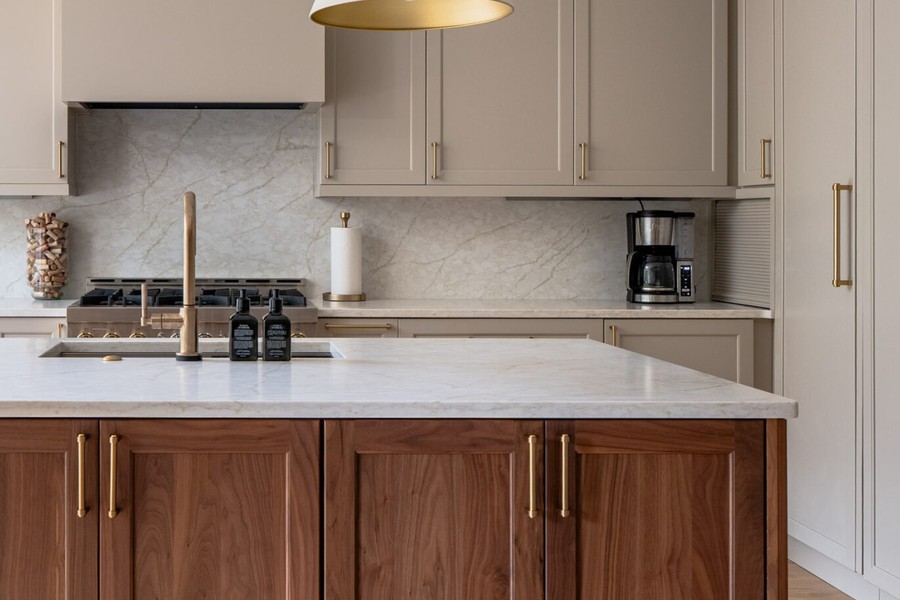
If you want to see how shaker reads in a finished, professionally designed kitchen rather than a product photo, our kitchen design ideas gallery and our transitional kitchen renovation in McLean are good places to start.
Frequently asked questions
Are shaker cabinets out of style?
No. Shaker is the most-installed cabinet door style in 2026, chosen by 58% of homeowners getting new or upgraded cabinets. The style most likely to feel dated is specifically thick-framed, stark-white shaker, not shaker as a category.
Will shaker cabinets look dated in 10 years?
It’s unlikely if they’re well executed. Shaker has stayed popular for decades because the plain frame adapts to changing colors, hardware, and countertops. A timeless color and a quality build matter far more to longevity than the door shape.
Do shaker cabinets add resale value?
They support it. A minor kitchen remodel using shaker-style fronts recoups around 107% of its cost in the Middle Atlantic region, and desirable listings often mention shaker. Cabinets alone don’t guarantee a premium, so treat resale as one factor in a well-designed kitchen rather than the reason to choose shaker.
Are shaker cabinets more expensive than flat-panel?
Not because they’re shaker. Door profile isn’t the main cost driver. What you pay is set by construction tier, material, and finish, so a basic flat-panel can cost less than custom shaker and a custom slab can cost more.
What’s replacing shaker cabinets in 2026?
Nothing is replacing it outright. Flat-panel and slab doors are gaining as an alternative, mainly in contemporary and handleless kitchens, while within shaker the move is toward slimmer profiles, warmer color, and textured details.
Planning a kitchen with shaker cabinets?
Shaker is a safe, lasting choice, and the difference between a shaker kitchen you love for a decade and one you regret comes down to color, profile, and how well it’s built. If you’re weighing it for a real remodel in Northern Virginia, Maryland, or D.C., we can help you see the options side by side and design the whole room around them. Book a showroom visit at our McLean or Bethesda location to compare shaker profiles and finishes in person.