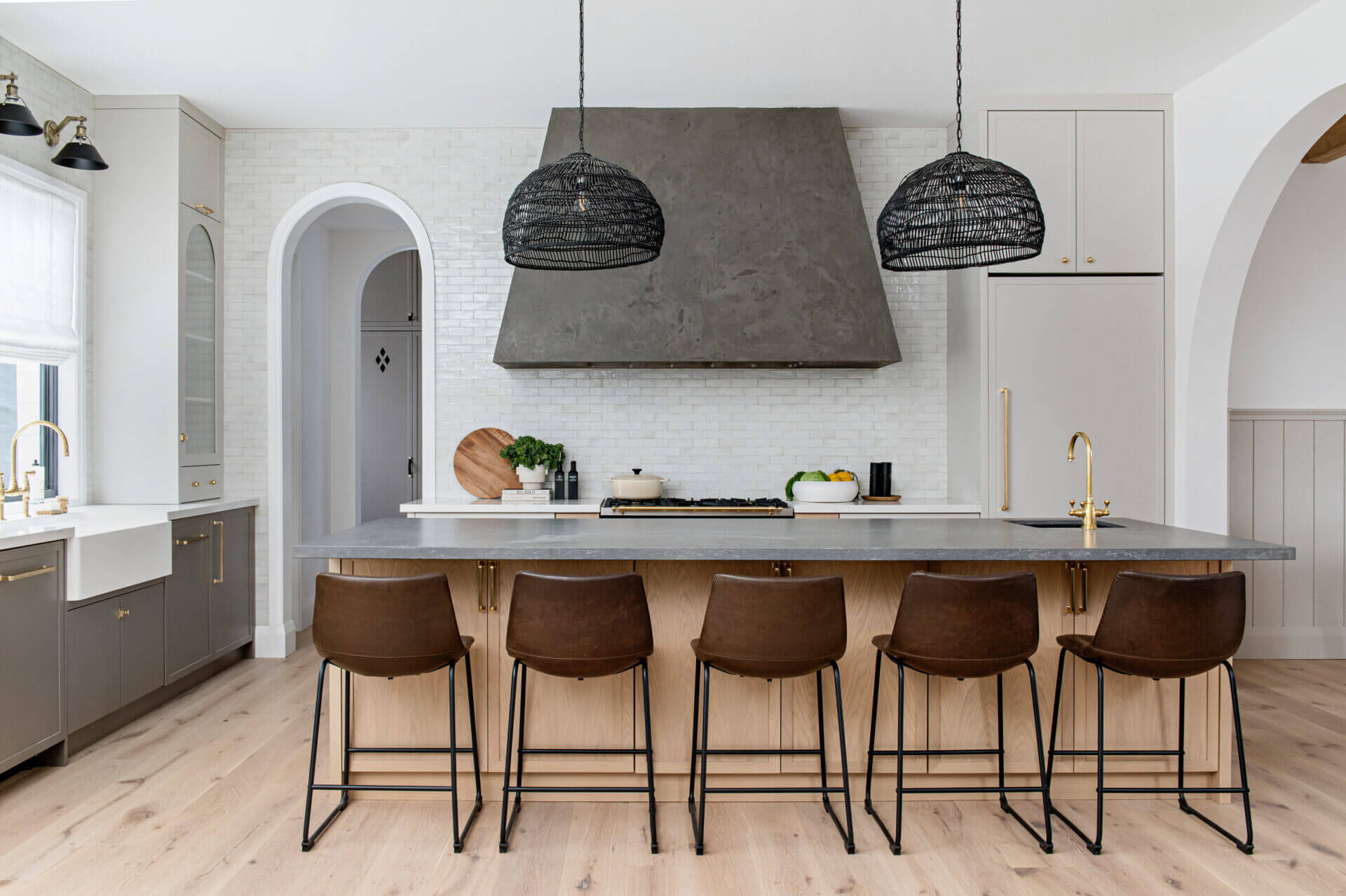
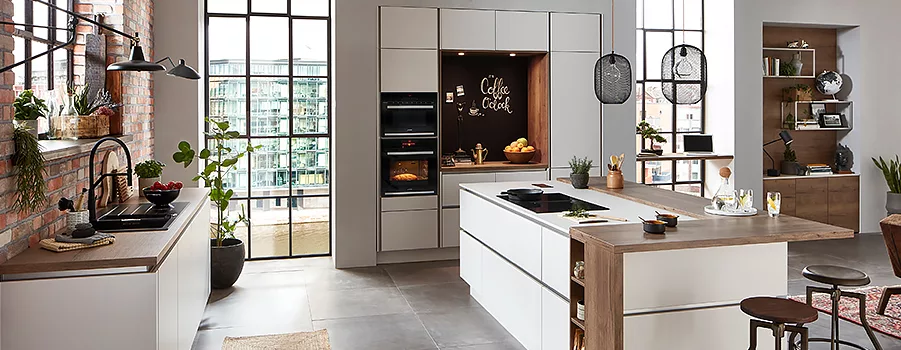
A German kitchen is a modular cabinetry system built to industrial standards, featuring frameless construction, precision hardware, and minimalist design. Unlike traditional American cabinetry, German kitchens are engineered as integrated systems where every component works together with tolerances measured in fractions of a millimeter.
At Boss Design Center, we’ve installed German kitchen systems from brands like Leicht and Bauformat for over a decade. The difference in quality becomes obvious the moment you open a drawer or close a cabinet door. These kitchens are built to perform for 20 years or more, which is why they’ve become the standard for homeowners who prioritize durability alongside design.
This guide covers everything you need to know about German kitchens: their history, how they’re constructed, what makes them different from American and Italian alternatives, and whether they’re the right choice for your home.
The Origins of the German Kitchen
The modern fitted kitchen traces directly back to 1926, when Austrian architect Margarete Schütte-Lihotzky designed the Frankfurt Kitchen for a social housing project in Germany.
Schütte-Lihotzky applied industrial efficiency principles to domestic space. She conducted time-motion studies to track steps taken during meal preparation, then designed a compact kitchen (roughly 6 feet by 11 feet) that minimized physical effort. According to MoMA’s documentation of the design, her innovations included:
- Unified work surfaces: Before this, kitchens had standalone furniture at varying heights. Schütte-Lihotzky introduced the continuous countertop.
- Material selection based on function: Oak for flour containers (repels mealworms), beech for cutting surfaces (resists staining and knife marks).
- Mass production: Over 10,000 units were manufactured and installed, proving that quality kitchen design could be industrialized.
This project established the DNA of German kitchens: standardized, mass-produced systems designed through rigorous analysis of function. As Häcker notes in their brand history, modern manufacturers view their automated production lines as spiritual successors to Schütte-Lihotzky’s vision of efficient, democratic design.
The Kitchen Mile: Where German Kitchens Are Made
Following World War II, the German kitchen industry consolidated in North Rhine-Westphalia, specifically the districts of Herford and Minden-Lübbecke. This region, called the Küchenmeile (Kitchen Mile), houses the headquarters and factories of Nobilia, Häcker, SieMatic, Poggenpohl, Nolte, and Bauformat within a few dozen kilometers.
This concentration created several advantages:
| Factor | Impact |
| Supplier proximity | Hardware manufacturers like Hettich located nearby, enabling rapid prototyping |
| Specialized workforce | A labor market of wood technicians, engineers, and designers developed |
| Logistical efficiency | Infrastructure optimized for shipping thousands of kitchens daily |
The cluster effect means knowledge transfers between companies, raising quality standards across the entire region.
How German Kitchens Are Built
The real difference between a German kitchen and standard cabinetry is often invisible. It’s in the box construction, the materials, and the hardware.
Frameless vs. Framed Construction
German kitchens use frameless (also called “full-access”) construction:
- German system: Thick structural side panels (16mm or 19mm) with hinges anchored directly into them. No face frame.
- American system: A solid wood face frame attached to a plywood box, with hinges attached to the frame.
The practical difference? Frameless construction offers approximately 15% more usable interior space. There’s no center stile or lip to maneuver around when accessing contents.
The Material Question: Why Engineered Board Beats Plywood
In North America, “plywood” is often marketed as premium while “particleboard” carries a stigma. German engineering challenges this assumption.
High-density furniture-grade chipboard (MFC) is isotropic, meaning it has no grain direction. This makes it dimensionally stable. It won’t warp or twist with humidity changes.
For frameless kitchens, this stability is critical. The gaps between doors are calibrated to 3mm or 4mm. Any warping destroys the visual alignment. German manufacturers choose MFC for its predictability over the potential movement of plywood.
Thickness specifications by tier:
- Standard German cabinets: 16mm side panels
- Premium lines (Ballerina, Häcker Systemat): 19mm panels for increased rigidity
- Back panels: 8mm solid panels grooved into sides (not thin hardboard tacked on)
According to Leicht’s cabinet construction specifications, the back panel is grooved (dadoed) into the side panels, effectively acting as a structural beam that prevents the cabinet from racking under load.
Laser Edging: The Zero-Joint Technology
Traditional edgebanding uses adhesive to attach strips to raw panel edges. Over time, the glue line discolors, attracts dirt, and can delaminate from heat and moisture.
Laser edging eliminates the adhesive entirely. A pre-applied polymer layer on the edgeband is melted by laser or superheated air at the moment of contact, fusing the materials together. The result is a seamless transition between panel surface and edge.
This matters for kitchens because the fused seal is impervious to steam and water. Cabinetry near dishwashers and kettles lasts significantly longer.
The Plinth System: Protection from Water Damage
German kitchens sit on adjustable plastic or metal legs, not a wooden toe kick platform.
Why this matters:
If your dishwasher leaks, water flows across the floor around the plastic legs. The cabinet carcass sits 10-15cm above the floor, staying dry. With an American ladder base, the wooden platform sits in the water and wicks moisture upward, potentially ruining the cabinetry.
The legs also allow precise leveling regardless of floor irregularities and let you customize countertop height without altering cabinet dimensions.
Hardware and the “Feel” of Quality
The tactile experience of a German kitchen is defined by its hardware. When clients visit our McLean or Bethesda showrooms, the first thing they notice is how drawers and doors operate.
Drawer Systems
German kitchens use runner systems from manufacturers like Hettich and Blum. The specifications exceed residential standards:
| Specification | German Standard | Typical US Standard |
| Load capacity | 40-80 kg (88-176 lbs) | 34-45 kg (75-100 lbs) |
| Cycle testing | 60,000-80,000 cycles | Varies widely |
| Soft-close | Standard, integrated | Often an add-on |
The “soft-close” mechanism isn’t bolted on as an afterthought. It’s built into the runner architecture using fluid dampers that decelerate the drawer in the final centimeters.
Hinge Technology
German hinges feature 3-dimensional adjustment: height, side, and depth. This adjustability is what allows installers to achieve consistent 3-4mm gaps between all doors, creating the clean lines that define the modern aesthetic.
Intelligent Storage Solutions
German engineering handles blind corners differently than American kitchens. Instead of a basic lazy susan, you’ll find:
- Le Mans systems: Kidney-shaped shelves that swing completely out of the cabinet
- Magic Corner units: Mechanical linkages where pulling the door brings nested baskets from the deep corner into the opening
These solutions exist because German manufacturers obsess over maximizing every cubic centimeter of storage.
Design Philosophy: From Laboratory to Living Space
The Frankfurt Kitchen was an isolated, clinical workspace. Today’s German kitchen has evolved into the Wohnküche, or “living kitchen.”
Clean Lines and Handleless Design
The dominant German aesthetic features flat-panel doors, minimalist hardware (or no hardware at all), and uninterrupted horizontal lines. This comes directly from Bauhaus principles: form follows function.
Handleless kitchens use a recessed metal channel (C-channel or Griffmulde) routed into the cabinet, allowing you to grip the back of the door. This creates visual continuity that makes spaces feel larger.
Adapting German Precision for American Homes
One challenge we see at Boss Design Center is the perception that German kitchens are “cold” or “clinical.” The truth is that German manufacturers now offer extensive options for warmth:
- Natural Living styles: Wood accents, earth tones, and textured finishes that soften the precision
- Modern Classic lines: Simplified shaker-style doors with the frameless, high-tech carcass underneath
- Cottage aesthetics: Framed looks that mimic traditional design while retaining German engineering
The German “machine” runs silently in the background while the living takes center stage.
2026 Design Trends
The era of the all-white high-gloss kitchen is fading. Current directions include:
- Japandi aesthetic: A fusion of Japanese minimalism and Scandinavian functionality, featuring vertical wood slats, light oaks, and stone textures
- Dark palettes: Black, taupe, and graphite are becoming the new neutrals
- Smart integration: LED lighting in handle channels controllable via smartphone, wireless charging pads in countertops, and motorized appliance lifts
German vs. Italian vs. American Kitchens
German vs. Italian
| Factor | German | Italian |
| Philosophy | Rationalism: logic, order, precision | Emotion: social interaction, expressive materials |
| Strength | Consistency, hardware integration, carcass durability | Design innovation, aesthetic boldness |
| Best for | Clients who want the kitchen to work like a machine for 20 years | Clients who want the kitchen to look like art |
Italian design is world-class, but German manufacturing is generally regarded as superior for consistency and long-term durability.
German vs. American
| Factor | German | American |
| Measurement | Metric (30cm, 40cm, 45cm, 60cm widths) | Imperial (inches) |
| Customization | “Industrial bespoke”: factory robots cut to exact specifications | “Local custom”: carpenter builds to fit on-site |
| Finish quality | UV-cured industrial finish | Varies by contractor skill |
| Lead time | 12-16 weeks (shipped from Europe) | 4-8 weeks for semi-custom |
German kitchens require careful design planning to fit metric cabinets into imperial wall spaces, often using filler panels or precise resizing. The longer lead time is the trade-off for industrial precision.
Quality Standards: DIN and RAL Certifications
A “German kitchen” isn’t just marketing. It’s a verifiable status backed by rigorous standards.
DIN 68930: The Durability Standard
DIN 68930 specifies exactly what a kitchen must withstand. According to the German Kitchen Center Quality Guide:
- Climate resistance: Materials tested in chambers cycling between high humidity/heat and dry/cold conditions
- Heat resistance: Surfaces must handle 180°C dry heat and 100°C steam
- Load testing: Shelves loaded with 75 kg/m² for weeks, measuring deflection
- Cycle testing: Drawers must survive 60,000-80,000 opening and closing cycles (15-20 years of intense daily use)
RAL-GZ 430: The Golden M
The Golden M is the highest quality mark from the German Furniture Quality Assurance Association. As COSMOB explains, it covers:
- Emission Class A: Strict limits on volatile organic compounds (VOCs), including formaldehyde
- Safety: Tipping stability, glass safety, absence of sharp edges
- Production audits: Unannounced factory inspections ensure mass-produced units match test samples
The emission certification matters for families concerned about indoor air quality. Cabinets bearing this mark won’t off-gas the “new furniture smell” associated with cheaper products.
GS Safety Seal
The GS Seal (Geprüfte Sicherheit) certifies that furniture poses no mechanical danger. This includes tipping hazards for tall units, rounded edges to prevent injury, and tempered safety glass in cabinet doors.
German Kitchen Brand Tiers
The German market is stratified. Understanding the hierarchy helps you evaluate what you’re actually buying.
| Tier | Brands | Characteristics | Price Range |
| Ultra-Luxury | Bulthaup, SieMatic, Poggenpohl | Bespoke production, exotic materials, hand-finishing | $$$$$ |
| Premium | Leicht, Häcker Systemat, Schüller | High customization, 19mm carcass options, architectural flexibility | $$$-$$$$ |
| Volume/Value | Nobilia, Bauformat, Nolte | Highly automated, standardized dimensions, best value-for-money | $$-$$$ |
At Boss Design Center, we work primarily with Leicht and Bauformat. Leicht serves high-end custom remodels with architectural flexibility. Bauformat provides an accessible entry point into German engineering for homeowners who want the durability without ultra-bespoke pricing.
A Note on Private Labels
Some US showrooms sell “German kitchens” under house names, obscuring the actual manufacturer. When we specify Leicht or Bauformat on a project, you can verify the pedigree independently. Transparency matters when you’re making this level of investment.
Is a German Kitchen Right for You?
German kitchens make sense if you:
- Plan to stay in your home long enough to benefit from 20+ year durability
- Value precision and consistency over handcrafted character
- Want storage solutions that maximize every inch
- Prefer modern or transitional aesthetics (though traditional looks are available)
- Can accommodate 12-16 week lead times
They may not be the best fit if you:
- Need cabinets in 4-6 weeks
- Prefer the character of site-built, hand-finished woodwork
- Have a very tight budget (German engineering comes at a premium)
What to Expect: Timeline and Process
German kitchen projects typically follow this timeline:
- Design phase (4-8 weeks): Measurements, 3D renderings, material selection
- Order and manufacturing (8-12 weeks): Factory production in Germany
- Shipping (2-4 weeks): Ocean freight to US distribution
- Installation (1-2 weeks): Specialized installation by trained fitters
Total timeline: 15-26 weeks from design finalization to completed kitchen.
The wait reflects the manufacturing precision. Every cabinet is made to order with your specific dimensions, finishes, and hardware configurations.
Getting Started with a German Kitchen
If you’re considering a German kitchen for your home in the Washington, D.C. metro area, the first step is understanding what’s possible within your space and budget. At Boss Design Center, we offer free consultations at our McLean and Bethesda showrooms where you can see German cabinetry in person, test the hardware, and discuss your project with our design team.
We’ll walk you through material options, explain the differences between brands, and provide realistic timelines and pricing. Whether you choose to work with us or not, you’ll leave with a clear understanding of what a German kitchen can offer.
Contact Boss Design Center to schedule your consultation.
AUTHOR