The best kitchen remodeling contractor in Maryland isn’t necessarily the one with the lowest quote. It’s the firm that can prove it’s legally allowed to work in your home, has a documented process for both design and construction, and will commit to clear contract terms: scope, timeline, payment schedule, and how changes are handled.
Maryland has unusually strong consumer protections built into its licensing and contracting laws, which makes your vetting process more straightforward than in many other states. At Boss Design Center, kitchen remodeling accounts for 80% of our project work across Maryland and Virginia, and the contractors who can’t meet these standards are easy to identify once you know what to look for.
This article covers Maryland contractors’ legal requirements, how to evaluate true competence beyond the basics, essential contract terms, and red flags that should end discussions immediately.
What Maryland Law Requires Before Any Contractor Can Work in Your Home
Three things need to be verified before any contractor makes your shortlist: license status, insurance coverage, and what consumer protections you’d forfeit if either is missing.
Confirm They Hold an Active Mhic License
In Maryland, it is illegal to act as a home improvement contractor or salesperson without a valid license issued by the Maryland Home Improvement Commission (MHIC). This isn’t just a formality. Your access to Maryland’s consumer protections, including the state’s Guaranty Fund, depends entirely on whether the contractor you hired was licensed at the time of the work.
Maryland provides a free public license lookup called the Home Improvement Public Query. You can search by business name, trade name, location, or license number. Do this before you schedule a consultation, not after you’ve already received a proposal.
When you pull the license, confirm that the business name on the license matches the entity named in the contract. These don’t always match automatically if a contractor operates under a trade name.
How Much Insurance Does a Maryland Kitchen Contractor Need to Carry?
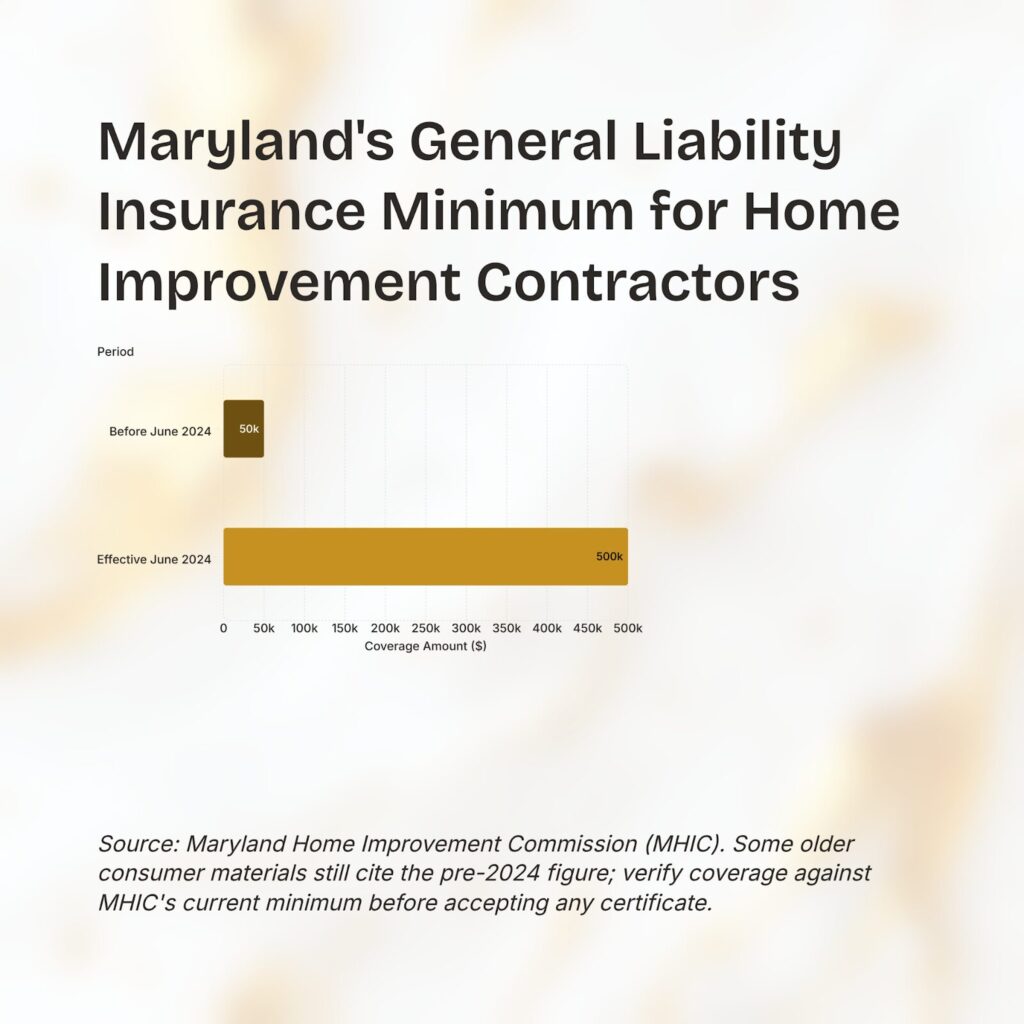
As of June 1, 2024, Maryland requires home improvement contractors to carry at least $500,000 in general liability insurance. Some older consumer materials reference a lower threshold, so go directly to the MHIC’s current guidance and request a certificate of insurance that confirms active coverage dates. Also ask about workers’ compensation coverage for the crew working in your home.
What Is Maryland’s Guaranty Fund, and What Does It Cover?
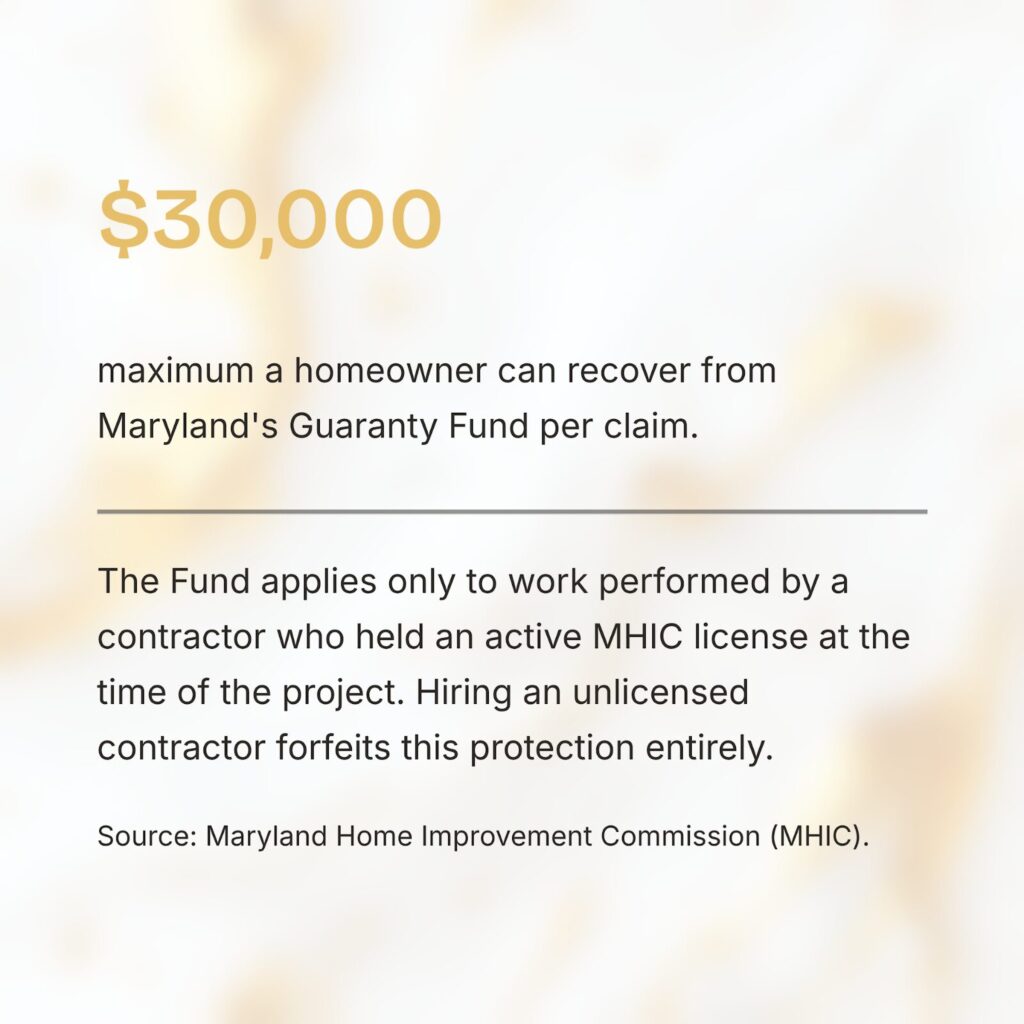
Maryland operates a contractor-supported Guaranty Fund that can compensate homeowners for documented monetary losses due to poor workmanship or failure to perform. Two important limitations: it only applies to work done by a licensed contractor, and recovery is capped at the amount you paid, up to $30,000. If you hire an unlicensed contractor, you cannot file a Guaranty Fund claim. That protection disappears entirely.
How Many Bids Should You Get, and How Do You Compare Them?
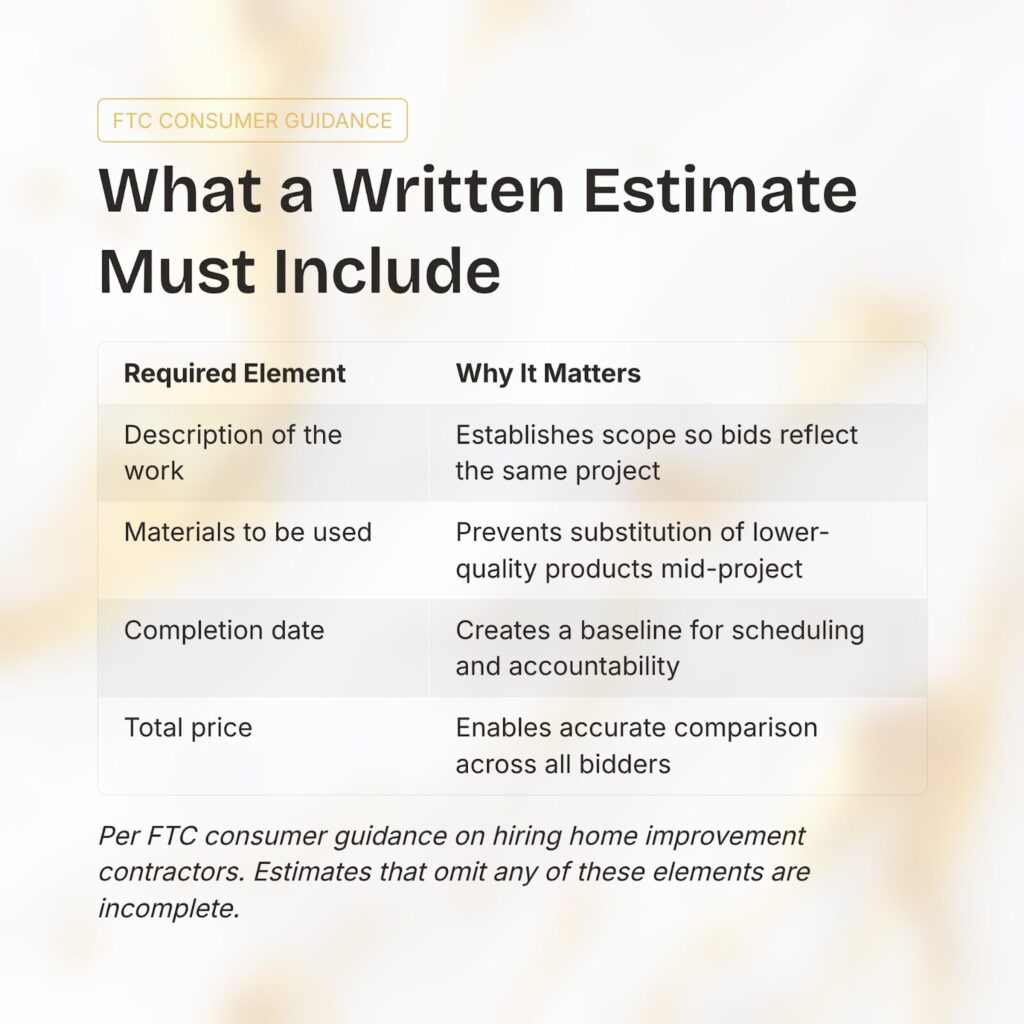
Maryland consumer guidance recommends getting at least three written estimates. The estimates need to be based on the same project description. Otherwise you’re not comparing equivalent proposals.
The Federal Trade Commission makes the same point: a written estimate should include a description of the work, materials, completion date, and price. It also warns against automatically choosing the lowest bidder and suggests asking why an estimate is much higher or lower than the others.
A bid that comes in significantly below the cluster of other estimates is usually missing something: scope items, quality of materials, or proper allowances for permitting and project management. When you ask the contractor to explain the difference and they can’t give a clear answer, that’s a meaningful signal.
What Else Should You Check Beyond Licensing and Insurance?
Licensing and insurance confirm a contractor is legally eligible to do the work. They say nothing about whether the contractor is actually good at it. Beyond the legal baseline, check for kitchen-specific experience, design capability, transparent subcontracting practices, and verifiable references.
- Experience with kitchens specifically. Ask how many kitchen remodels they complete per year and request recent examples. General remodeling experience doesn’t automatically transfer to kitchen work, which involves coordination across cabinetry, countertops, plumbing, electrical, ventilation, and structural modifications.
- Who actually does the work. Find out whether the firm uses its own employees or subcontracts most of the labor. If subcontractors are involved, confirm they’re licensed where required. Ask who will be on-site daily and who you contact if something needs to be addressed mid-project.
- Design capability. Kitchen outcomes are heavily influenced by design decisions made before a single cabinet is installed. Layout, clearances, lighting placement, and storage configuration all matter. A contractor who builds what you sketch on paper is different from one with a designer on staff who can pressure-test your ideas and improve them. The National Kitchen & Bath Association (NKBA) certifies designers who meet specific experience, education, and exam standards. That’s not a requirement, but it’s a concrete credential to ask about.
- References and portfolio. Ask for clients from the past two years and, where possible, request to see a finished kitchen. Photos are helpful; visiting a completed project is better.
What Should a Maryland Kitchen Remodeling Contract Include?
Maryland sets a legal floor for what every home improvement contract must contain. Beyond that floor, there are two additional areas worth scrutinizing before you sign: how the contract handles unselected materials, and how it deals with changes once construction starts.
Required Contract Terms Under Maryland Law
Maryland requires every home improvement contract to be in writing, signed by both parties, and given to you before work starts or money changes hands. At minimum, the contract must include:
- The contractor’s legal name, address, and MHIC license number
- Start and substantial completion dates
- A description of the work and materials to be used
- The total price
- Required MHIC notices, including information about the Guaranty Fund
If any of these are missing when a contract is placed in front of you, send it back for revision.
How Much Can a Maryland Contractor Require as a Deposit?

Maryland law limits the initial deposit to one-third of the contract price. The contractor cannot accept any payment before the contract is signed. Beyond the deposit, the law doesn’t dictate the rest of the payment schedule, which means you can negotiate milestone-based payments. Retaining a meaningful final payment until punch-list completion is a reasonable and common practice.
The Allowances Problem
Pay close attention to how the contract handles materials you haven’t selected yet. Many contractors use allowances (placeholder amounts like “$10,000 for countertops”) that get settled during construction. The Maryland People’s Law Library specifically flags allowances as a risk area, noting that actual costs frequently exceed estimates, leaving homeowners to absorb the difference mid-project when they’re already committed.
The more specific the contract is before construction starts, the less exposure you have to cost surprises. Ask every contractor you’re evaluating: “What items in this contract are covered by allowances, and what process do you use if those costs run over?”
Change Orders
Kitchens often reveal surprises after demolition begins. Make sure the contract defines exactly how changes are requested, approved, priced, and scheduled. Any change should be in writing before work proceeds on the modified scope.
What Are the Red Flags That Should End the Conversation Early
“Pressure plus paperwork gaps plus unusual payment requests” is the pattern that consistently precedes home improvement fraud. Specific warning signs:
- Pressure to sign the same day, especially after an unsolicited offer
- A request for full or near-full payment upfront
- Requests to pay in cash or through personal payment apps
- Contracts with blank spaces or vague scope descriptions
- Unwillingness to provide proof of license and insurance in writing
- A bid significantly below all others without a clear explanation
- No physical address or business presence that can be independently verified
The FTC also specifically warns about contractors who offer to arrange financing for your project and pressure you to sign loan documents quickly. Treat any financing discussion as separate from the construction agreement and consult independently before signing anything linked to your home as collateral.
Do Maryland Kitchen Contractors Need Lead-Safe Certification?
Yes, in most cases involving older homes. If your home was built before 1978 and the project will disturb painted surfaces (which kitchen demolition almost always does), the EPA’s Renovation, Repair and Painting (RRP) program requires the contractor to be lead-safe certified, with limited exceptions. This is both a health and legal compliance issue.
Ask every contractor you’re evaluating whether they hold lead-safe certification and what containment and cleanup practices they use. Document the answer in writing.
Maryland Kitchen Remodeling Contractor Checklist
Use this table when evaluating any finalist for a Maryland kitchen remodel.
| What to verify | Why it matters | How to check |
|---|---|---|
| Active MHIC license | Required by law; gateway to consumer protections | Maryland Home Improvement Public Query |
| Business name matches contract | License name and contracting entity must align | Compare license record to proposal |
| General liability insurance ($500K+) | Current Maryland minimum as of June 2024 | Request certificate of insurance |
| Workers’ compensation coverage | Protects you if a worker is injured on your property | Ask for proof alongside liability certificate |
| Complaint history | MHIC investigates complaints; history reveals patterns | Check directly with MHIC |
| Written contract with required terms | Maryland law mandates specific content | Review against MHIC checklist before signing |
| Deposit at or below one-third | Maryland law; limits your exposure if performance slips | Confirm in writing before signing |
| Milestone payment schedule | Ties remaining payments to verified progress | Negotiate into contract terms |
| No open-ended allowances | Allowances shift budget risk to you mid-project | Ask contractor directly; read contract carefully |
| Written change-order process | Defines how scope changes are priced and approved | Confirm process is in the contract |
| Kitchen-specific portfolio and references | Proves competence in this specific type of work | Request examples; contact past clients |
| Lead-safe certification (pre-1978 homes) | EPA RRP compliance; health and legal requirement | Ask directly and document the answer |
How Boss Design Center Addresses These Standards
We hold active contractor licenses in Maryland, Virginia, and DC, carry the required insurance, and handle all permits in-house.
Those are baseline requirements. Any contractor you’re seriously considering should be able to show the same.
Where we differ is in how we have structured the contract and process to eliminate the risks that most commonly derail kitchen projects.
We have eliminated allowances entirely. Every detail is selected before construction begins: cabinets, countertops, tile, hardware, fixtures, grout color. That upfront selection process is what makes a genuinely fixed-rate contract possible. If your project is quoted at $200,000, it finishes at $200,000.
Change orders occur in two situations only: structural issues uncovered during demolition, or scope additions the client chooses to make.
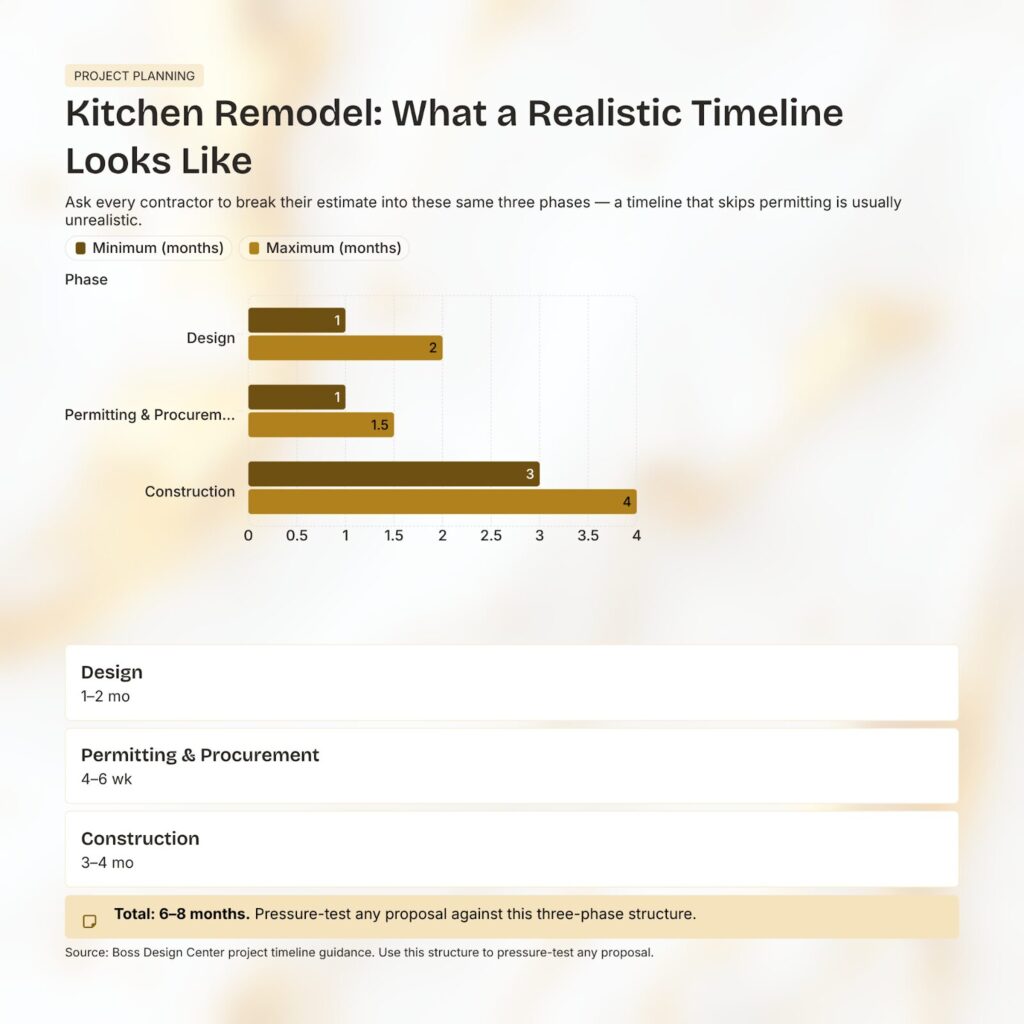
Our process runs in three distinct phases: one to two months for design, four to six weeks for permitting and procurement, then three to four months of active construction. Six to eight months in total. When comparing proposals, ask every contractor to break their timeline into the same three phases: design, permitting and procurement, and construction. A timeline that compresses or skips the permitting phase is usually unrealistic.
Before construction begins, we provide photorealistic 3D renderings of your finished kitchen. You see exactly what you are getting before a single cabinet is installed. It is also the most practical way to prevent the misalignment that is nearly impossible to correct once construction is complete.
Ready to Start Evaluating Contractors?
If you’re planning a kitchen remodel in Maryland and want to understand exactly what our process looks like, we offer a free in-home consultation. We’ll walk through your space, discuss your goals and budget, and give you an honest assessment of what’s realistic, including anything that won’t work. Schedule your free consultation here.
AUTHOR