In Washington, DC, a kitchen remodel in 2026 typically costs between $28,600 and $165,000, depending on the scope, finishes, and complexity of the work. More extensive design-build renovations with custom cabinetry, layout changes, and higher-end materials often fall between $80,000 and $250,000.
The gap between those ranges reflects the remodel you choose. At Boss Design Center, the kitchen remodeling projects we handle in the DC metro area typically fall somewhere in that upper range.
In this article, we break down what different budget levels usually cover, why kitchen remodels in DC cost more, and how to figure out what your project is actually likely to cost.
DC Kitchen Remodel Cost Benchmarks for 2026
The most useful starting point for budget planning is the Cost vs. Value report from the Journal of Light Construction. It breaks kitchen remodels into consistent, well-defined scopes, which makes the numbers genuinely comparable across cities and years. The figures below are from the 2024 report, updated to reflect 2026 construction prices using the Producer Price Index for construction materials.
Scope | What it includes | 2024 DC job cost | ~2026 planning figure |
Minor Kitchen Remodel (Midrange) | New cabinet fronts and hardware, countertops, sink, flooring, limited appliances. Cabinet boxes stay in place | $27,492 | ~$28,600 |
Major Kitchen Remodel (Midrange) | Full cabinet replacement with island, multiple appliances, lighting, flooring, paint | $79,982 | ~$83,200 |
Major Kitchen Remodel (Upscale) | Same scope as above, with higher-end materials and finishes | $158,530 | ~$164,900 |
These are benchmarks, not quotes. What you actually pay depends on your layout, the condition of your existing kitchen, how much structural work is involved, and the finishes you choose
What Design-Build Projects Actually Cost in DC
The Cost vs. Value benchmarks are useful for context, but they’re based on defined project scopes that don’t always match what homeowners are actually planning. A fully custom, design-build renovation typically lands in a different place.
Our kitchen projects in Washington DC typically run $80,000 to $250,000. That’s a wide spread, but the variables that move the number are genuinely significant: kitchen size, whether you’re changing the layout, how much structural work is involved, cabinet specification, and the appliance package.
A few things consistently push projects toward the higher end:
- Moving plumbing or gas lines to change the layout
- Removing walls or modifying load-bearing structure
- Custom or semi-custom cabinetry instead of stock
- High-end appliance packages (Sub-Zero, Wolf, Miele)
- Premium countertop materials like quartzite or natural stone
- Pre-1978 homes requiring lead-safe renovation protocols (more on this below)
Why DC Remodels Cost More than National Averages?
If you’ve been researching costs online and the DC quotes you’re getting seem high compared to what you’re reading nationally, there’s a straightforward reason: this is one of the most expensive labor markets in the country.
Labor Costs in the DC Metro
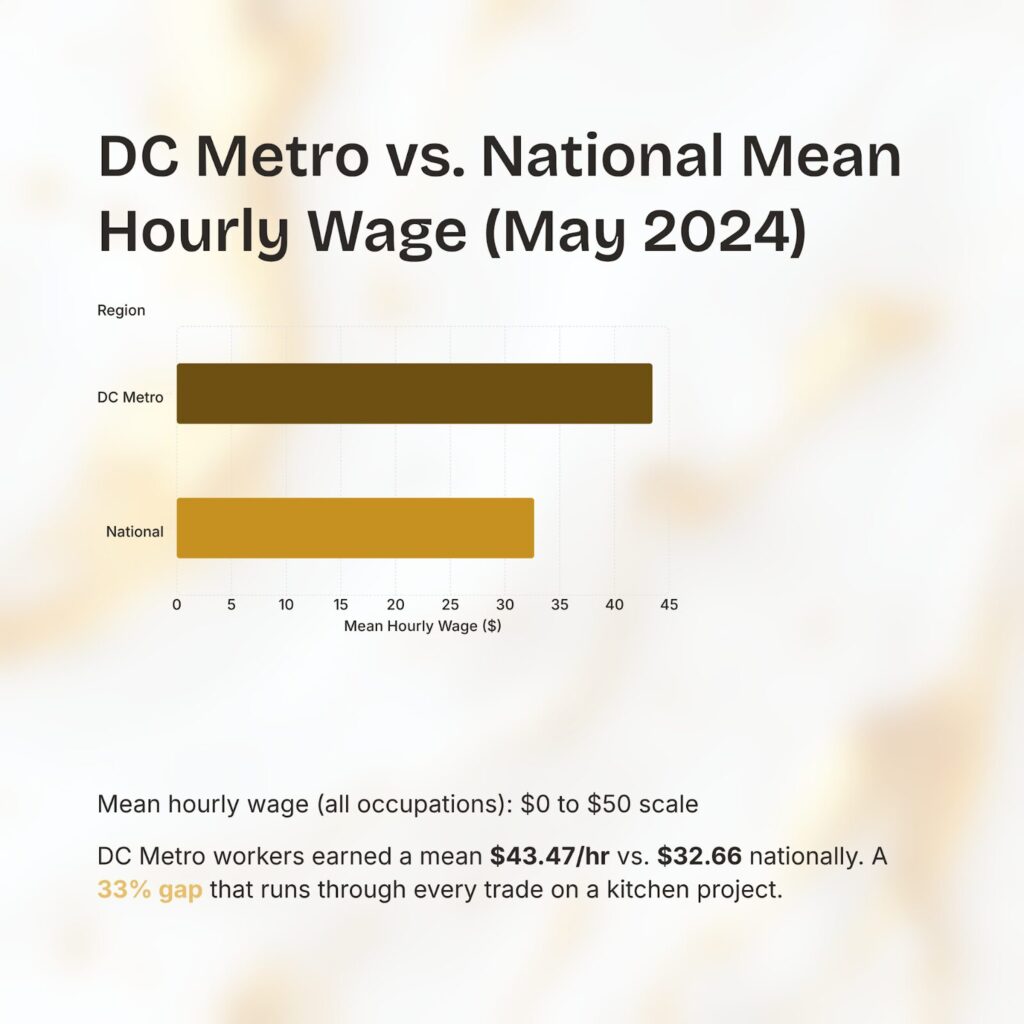
Tradespeople in DC get paid more than almost anywhere else. BLS wage data for the Washington-Arlington-Alexandria area puts the regional average hourly wage at $43.47 as of May 2024, compared to $32.66 nationally. That 33% gap runs through every trade on a kitchen job: carpenters, electricians, plumbers. And those are base wages.
Trade | Mean Hourly Wage (DC Metro) |
Carpenters | $28.81 |
Electricians | $36.47 |
Plumbers, Pipefitters, Steamfitters | $33.52 |
And those are base wages. By the time a contractor adds overhead, insurance, and margin, the labor cost embedded in a DC kitchen is meaningfully higher than in most other markets.
Materials Costs in 2026
Material prices have kept climbing. The National Association of Home Builders reported in early 2026 that building material prices are up 3.5% year-over-year, with costs continuing to rise through the end of 2025. The products that go into a kitchen, cabinetry, countertops, and appliances, don’t all move the same way, but the overall direction is up.
Finding Good Crews
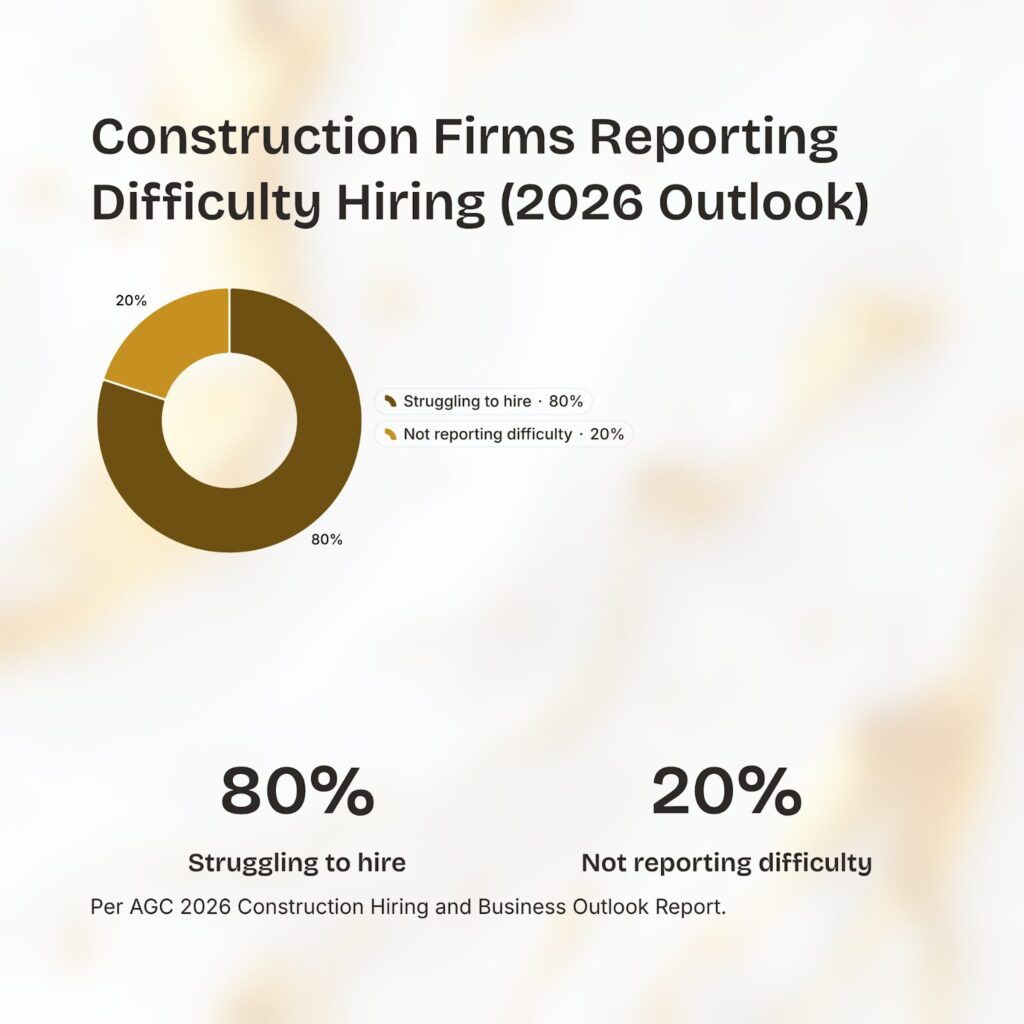
The best remodeling crews in DC stay booked. The Associated General Contractors of America found that more than 80% of construction firms struggle to find qualified workers heading into 2026. In a tight labor market, in-demand crews often carry longer lead times and higher rates, both of which show up in interior project costs.
DC Permit Costs to Budget For
Most kitchen remodels in DC require an Alteration and Repair permit from the DC Department of Buildings. The fee is based on your construction value, so it scales with your budget. There’s also a Green Building Fee on top of the base permit cost.
Here’s what that looks like at a few common budget levels:
Project value | Alteration & Repair fee | Green Building fee | Approx. combined total |
$30,000 | $693.00 | $42.90 | ~$735.90 |
$80,000 | $1,793.00 | $114.40 | ~$1,907.40 |
$150,000 | $3,333.00 | $214.50 | ~$3,547.50 |
These figures are calculated from the published DOB fee schedule and don’t include any additional trade permits your scope might trigger. The DOB also requires a 50% deposit upfront when you file, so permit costs tend to land in two stages rather than one payment at closing.
Lead-Safe Requirements in Older Homes
If your DC home was built before 1978 and your remodel will disturb painted surfaces, federal Lead Renovation, Repair and Painting (RRP) rules apply. The EPA requires this work to be performed by lead-safe certified contractors.
DC also has its own pre-renovation education and documentation requirements for compensated work in pre-1978 residential properties, outlined by the DC Department of Energy and Environment.
In practical terms, this adds line items for testing, containment, cleaning verification, and documentation. In older DC neighborhoods it comes up more often than people expect, and it’s worth accounting for before you get a bid.
Fixed-Rate vs. Allowance-Based Contracts
Before you sign anything, understand how the contract is structured. It matters more than most homeowners realize until they’re mid-project.
Many contractors use allowance-based contracts. The total looks reasonable, but it includes lines like “$8,000 cabinet allowance.” If the cabinets you actually want cost $14,000, you pay the difference. Multiply that across countertops, fixtures, and appliances, and the gap between the original quote and the final invoice can be significant.
At Boss Design Center, we use fixed-rate contracts. You select every material before construction starts, and the price we quote is the price you pay. If a project starts at $200,000, it ends at $200,000. Change orders do happen, but only in two situations: structural damage discovered after demolition, or scope additions you request beyond the original design.
When you’re comparing bids, ask directly whether the number is based on allowances or finalized selections. That answer will tell you a lot about where the actual cost is heading.
How to Set a Realistic 2026 Budget

The simplest approach is to match your project to one of the benchmark scopes above, then account for the DC-specific factors that push costs higher here than elsewhere.
If you’re doing a surface refresh, new cabinet fronts, countertops, a sink, flooring, and a few appliances without touching the layout, plan around $28,600 based on the DC benchmark.
If you’re doing a full replacement at midrange spec, new cabinetry including an island, multiple appliances, lighting, and flooring, the DC benchmark puts you in the low-$80,000s.
If you’re going upscale, higher-end materials, custom cabinetry, premium appliances, plan for something closer to $165,000.
If you’re working with a design-build firm on a full turnkey renovation, particularly one involving structural changes or a complex site, $80,000 to $250,000 is the realistic range for this market.
The factors most likely to push your budget above any of those starting points: DC labor costs, ongoing materials price pressure, permitting and compliance requirements in pre-1978 homes, and how the contract is structured.
Frequently Asked Questions About Kitchen Remodel in DC
Most homeowners come to us with the same handful of questions. Here’s what we tell them.
What Is the Most Expensive Part of Redoing a Kitchen?
Cabinetry is the largest single line item in most DC kitchen remodels, typically accounting for 30 to 40 percent of the total budget, with custom and semi-custom cabinets commonly running $30,000 to $60,000 or more. Countertops and appliances follow, particularly when the project involves natural stone or high-end appliance packages.
Labor is the most overlooked cost. The combined rates for carpenters, electricians, and plumbers in this market add up quickly, and on projects involving layout changes or structural work, labor can rival cabinetry as the largest line item.
How Much Does It Cost to Renovate a Bathroom in DC?
A midrange bathroom remodel in DC typically runs $20,000 to $45,000, while an upscale renovation involving custom tile work, a freestanding tub, or a full layout change can push $60,000 to $100,000 or more.
The same labor market factors that drive DC kitchen remodel costs apply here. Trade wages run about 33 percent above the national average, and that gap flows through every bathroom project the same way it does a kitchen.
What Kitchen Remodel Can Be Done with $25,000?
In Washington DC, $25,000 falls below the benchmark for even a minor remodel, which starts around $28,600. A cosmetic refresh is the most realistic scope at that budget: new cabinet fronts and hardware, a countertop replacement, and a new sink, with likely tradeoffs on appliances or flooring to stay within the number.
Layout changes, structural work, and full cabinet replacement are not realistic at this budget in this market.
How Long Does a Kitchen Remodel Take in Washington DC?
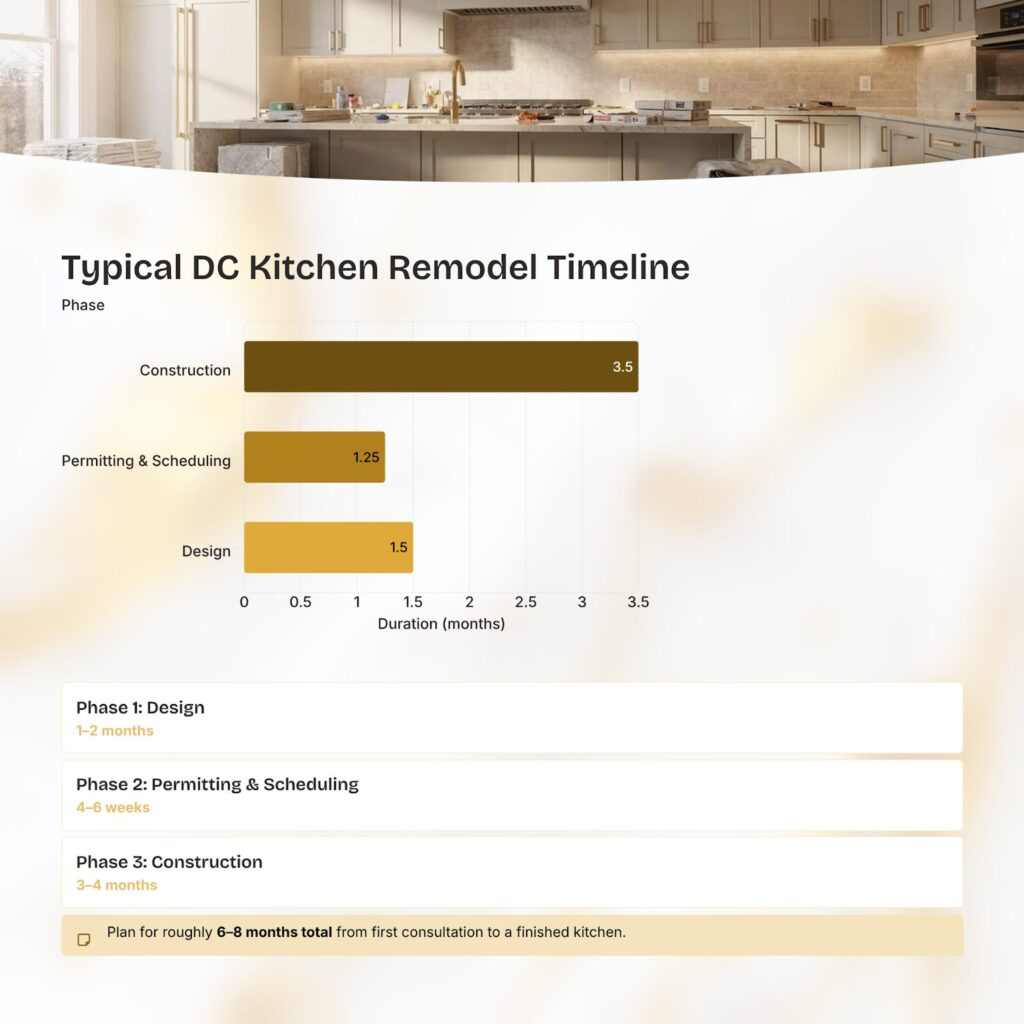
A typical kitchen remodel takes about 6 to 8 months from initial consultation to completion: roughly 1 to 2 months for design, 4 to 6 weeks for permitting and scheduling, and 3 to 4 months for construction. DC permitting timelines can vary depending on scope and current DOB workload.
Do I Need to Move Out During a Kitchen Remodel?
For most kitchen-only projects, homeowners stay in place. We protect adjacent areas and do daily cleanup to keep things livable. If you’re extending the scope to a whole-house remodel, phasing or a temporary relocation is worth a conversation.
What Should I Ask a Contractor Before Signing a Contract?
- Is the contract fixed-price or allowance-based?
- What triggers a change order?
- Are all material selections finalized before construction starts?
- Does my home’s age require any compliance upgrades that need budgeting?
These four questions reveal a quote’s reliability more than the bottom-line number.
Plan Your Kitchen Remodel With Someone Who Knows This Market
If you’re planning a kitchen remodel in Washington DC and want a realistic read on what your specific project is likely to cost, we offer free consultations at our Bethesda and McLean showrooms. We’ll give you a straight answer.
AUTHOR