

Choosing the right kitchen remodeling contractor in McLean comes down to a few non-negotiable fundamentals: proper Virginia licensing, verifiable insurance, a detailed written contract, and a clear payment structure. Skip any one of these and you’re taking on real financial and legal risk.
At Boss Design Center, we’ve been doing kitchen remodeling in McLean and the surrounding Northern Virginia area since 2014. We’ve also seen what happens when homeowners hire the wrong firm.
This guide details Virginia licensing rules, insurance must-haves, contract essentials, and deal-breaker red flags for McLean kitchen contractors.
Verify Virginia Contractor Licensing First
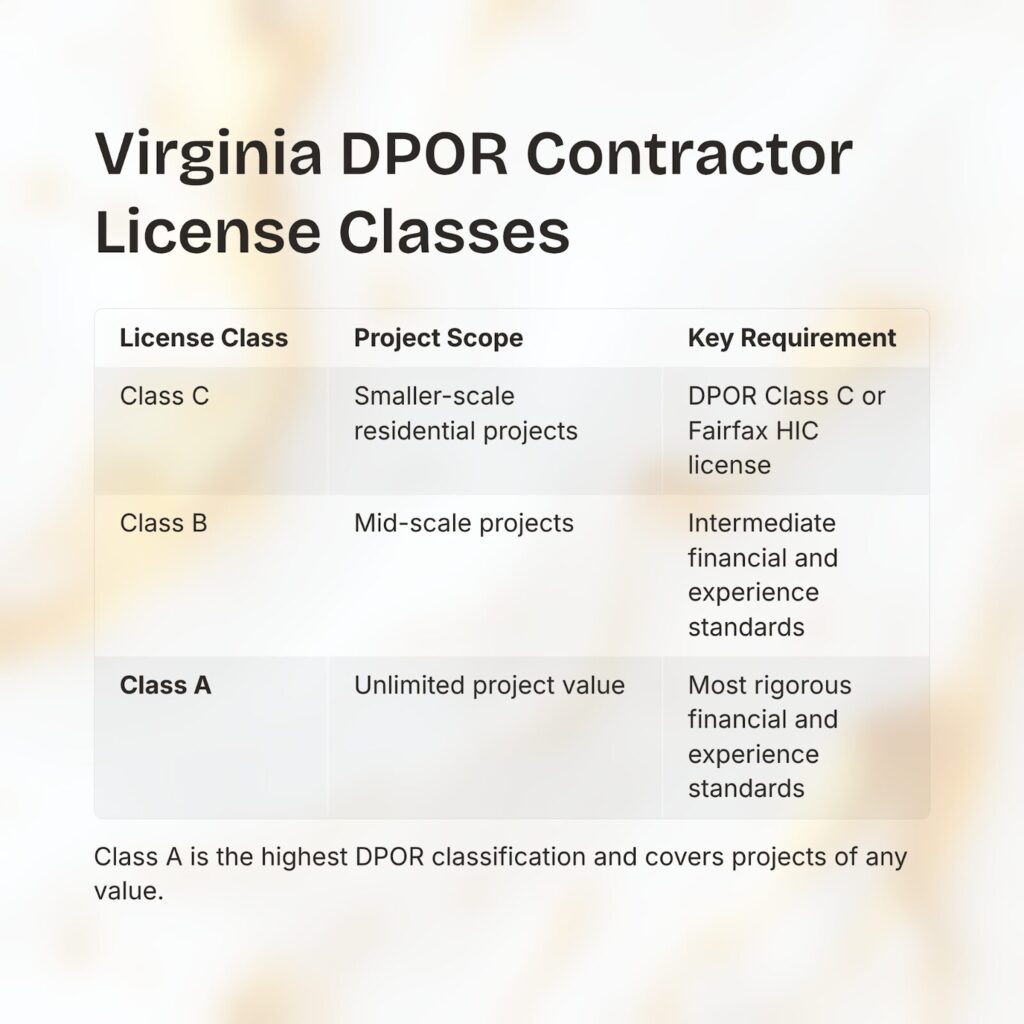
Licensing is the first thing to confirm when evaluating any kitchen contractor in Virginia. The DPOR Consumer Protection Statement requires that any contractor performing work valued at more than $1,000 hold a valid state license. Licenses are issued in three classes based on project value:
- Class C: projects from $1,000 but less than $10,000, with an annual cap of $150,000
- Class B: single projects from $10,000 but less than $120,000, with an annual cap of $750,000
- Class A: single projects of $120,000 or more, or more than $750,000+ in annual work
Because most kitchen remodels in McLean run well above the Class C ceiling, the contractor you hire will typically need a Class B or Class A license.
McLean falls within Fairfax County, which adds a local wrinkle. Per Fairfax County Land Development Services, any contractor operating under a DPOR Class C license (or doing work below the Class C threshold) must also hold a Fairfax County Home Improvement Contractor (HIC) license. The HIC is a local add-on, not a substitute for the DPOR license.
Ask any contractor you’re considering for their license number. Then verify it yourself using the DPOR License Lookup tool, which shows the license class, current status, and any disciplinary history. Checking takes about two minutes.
Boss Design Center holds a Virginia Class A license, which covers unlimited project values and requires stricter financial and experience standards than Class B or C. We also carry all Fairfax County credentials required for work in McLean.
If a contractor can’t provide a license number, or tells you they don’t need one, stop the conversation there.
Confirm Insurance and Bonding
Before any contractor steps foot in your home, ask for a certificate of insurance. You want to see two things:
- General liability insurance: covers property damage if something goes wrong during the job
- Workers’ compensation insurance: covers workers injured on your property
Without workers’ comp, you could be held liable if someone working in your kitchen gets hurt. Bonding provides an additional layer of protection if the contractor fails to complete the work or causes damage they refuse to fix.
Reputable contractors keep these policies active and can produce documentation without hesitation. We’re fully licensed, bonded, and insured, and we provide proof upfront whenever asked.
Get Multiple Written Estimates and Compare Them Properly
DPOR’s consumer guide on hiring a contractor advises homeowners to get written estimates from at least three contractors before making a decision. The key word is “written.” Verbal quotes aren’t worth much when a dispute arises.
More importantly, make sure each estimate is based on the same scope of work. If Contractor A is pricing a full gut renovation and Contractor B is working from a vague summary, the numbers won’t be comparable. Provide the same project brief to everyone you’re evaluating.
When you receive the estimates, look at more than the bottom line. A quote that’s significantly lower than the others usually means one of a few things: the contractor is cutting corners on materials, planning to hit you with change orders mid-project, or underestimated the job. Ask each bidder to walk you through how they arrived at their number.
At Boss Design Center, our kitchen remodeling projects typically range from $80,000 to $250,000, depending on scope, size, and materials. We use fixed-rate contracts with no allowances, which means the price we quote is the price you pay. Nothing is left as a placeholder that gets filled in later.
Know What a Legitimate Contract Must Include
Virginia regulations at 18 VAC 50-22-260 require licensed contractors to use written, signed contracts for residential work. If a contractor asks you to proceed on a handshake or a basic invoice, that’s a compliance issue, not just a red flag.
A proper contract should include:
- Full scope of work, including specific materials, brands, and finishes
- Project start and estimated completion date
- Total price and payment schedule
- How change orders are handled and priced
- The contractor’s license number, class, business address, and contact information
- Your name and property address
- Warranty terms for both workmanship and materials
- Cancellation rights and a notice about the Virginia Contractor Transaction Recovery Fund
Read the change order section carefully. This is where many homeowners get caught off guard. A well-run project shouldn’t require many changes, but when they do come up, the process should be transparent and in writing before any additional work begins.
We keep change orders rare at Boss Design Center by completing a comprehensive design phase before construction starts. Every material, finish, and fixture is selected before a single wall comes down, so there are no mid-project decisions or surprise costs.
Understand Payment Terms Before You Sign
DPOR’s consumer guidance is clear on this: the initial deposit on a residential remodeling contract should generally be no more than 10% of the total project cost, or $1,000, whichever is less. For projects involving special-order materials, up to 30% may be reasonable. But no reputable contractor requires full payment upfront.

Tie the payment schedule to project milestones rather than calendar dates. For example, a payment upon completion of demolition, another at cabinet installation, and a final payment after the walkthrough and punch list. This structure keeps the contractor accountable at each stage.
Demanding full payment in cash before work begins is one of the clearest warning signs of a scam or an unstable business. A financially sound contractor doesn’t need your entire budget before starting.
Who Handles the Permits?
Most kitchen remodels in McLean involve at least some electrical, plumbing, or structural work, all of which require Fairfax County building permits. Fairfax County Land Development Services strongly recommends that a properly licensed contractor, not the homeowner, pull permits on residential projects.
There’s a practical reason for this. When the contractor is the permit holder, the inspections are tied to their license. They’re responsible for making sure the work meets code at every stage. If a homeowner pulls their own permit, they may assume liability for code compliance that’s actually the contractor’s job.
Ask every contractor you’re evaluating who handles permitting. The answer should be them, without exception. We manage all permits at Boss Design Center, including building, electrical, plumbing, and any others required for a given project. We don’t perform work without the proper permits in place.
General Contractor vs. Design-Build: Which Model Works Better for McLean Kitchens?
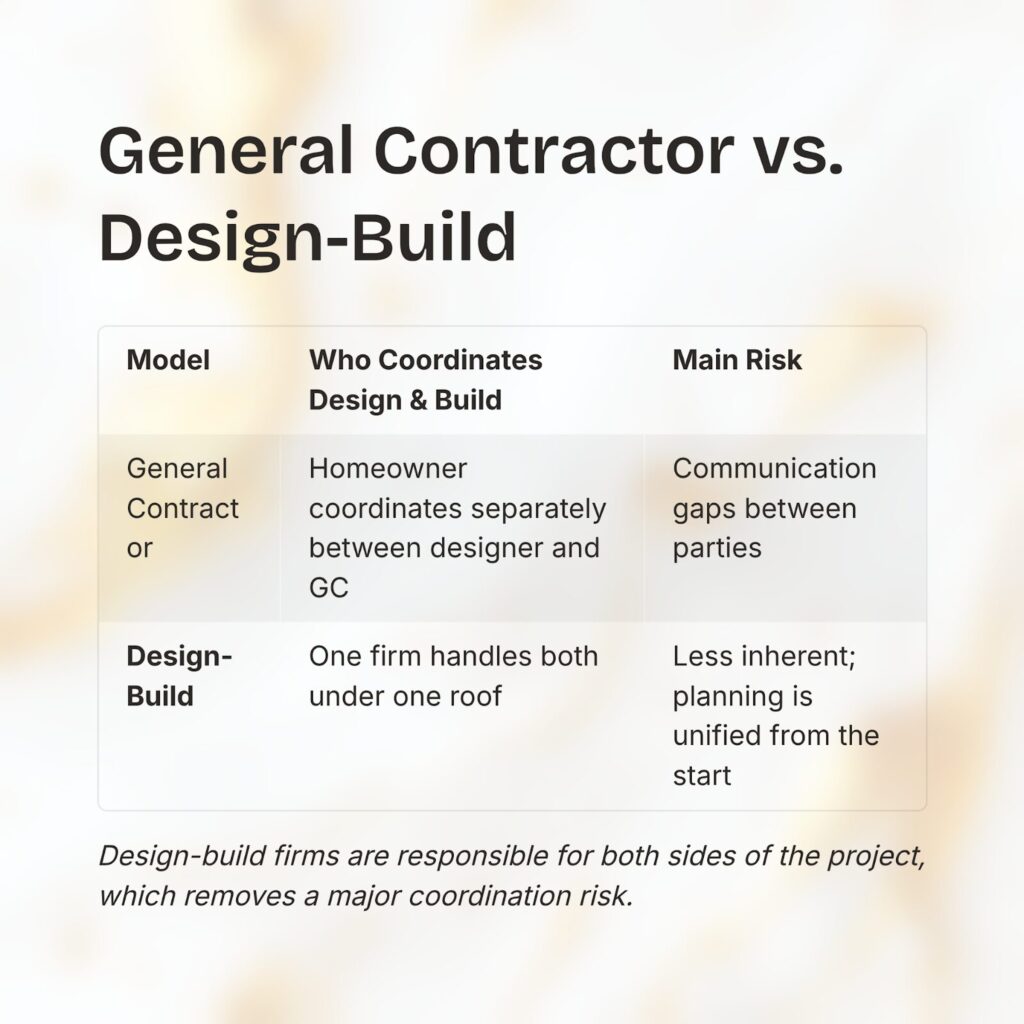
Most McLean homeowners will encounter two types of firms when shopping for a kitchen remodel.
The first is the traditional general contractor model. You hire a designer or architect separately, then bring in a GC to build out the plans. The two parties work in sequence, and you’re responsible for coordinating between them.
The second is the design-build model. One firm handles both the design and the construction under one roof. Your designer stays involved from the initial concept through the day the project is complete.
The design-build approach has meaningful practical advantages for kitchen projects. Because the same team is responsible for both the design and the build, there’s no finger-pointing when something doesn’t align. Decisions made during design are communicated directly to the construction crew. And because everything is planned comprehensively before work begins, the likelihood of surprises during construction drops significantly.
We’re a design-build firm. The same designer who creates your 3D renderings and selects your finishes stays with your project through the final walkthrough. That continuity matters on a job as detail-intensive as a kitchen remodel.
What to Look for in a Portfolio and References
A contractor’s portfolio tells you what they’re capable of. Look for projects with a similar scope and budget to yours, and pay attention to the quality of the finishes, the coherence of the design, and whether the overall aesthetic feels intentional or assembled.
If the firm has a Houzz profile, it’s worth reviewing. Houzz reviews are verified against actual projects, which makes them more reliable than general review platforms. We’ve earned Best of Houzz recognition across nearly a decade, including repeat wins for both design and service.
When checking references, ask past clients a few specific questions:
- Did the project finish on time and on budget?
- How were issues communicated when they came up?
- Would you hire this contractor again?
Vague praise means less than specific answers to those three questions.
Red Flags to Watch Out For
A few behaviors should stop the evaluation process immediately:
- No verifiable license number. Any contractor doing residential work in Fairfax County must be licensed. No exceptions.
- Full payment demanded upfront. Reputable firms don’t operate this way.
- No written contract. Virginia regulations require one. A contractor who won’t provide one isn’t operating within DPOR rules.
- Unusually low bids. If one estimate is dramatically below the others, the scope is probably incomplete or the contractor plans to recoup the difference in change orders.
- Cash only. Insisting on cash payments is a red flag for unlicensed or uninsured operators.
- High-pressure sales tactics. A quality contractor doesn’t need to push you to decide on the spot.
Contractor Vetting Checklist
Use this as your reference when interviewing contractors. Every item on this list has a specific way to verify it, so don’t rely on the contractor’s word alone.
| What to check | What to look for | How to verify |
|---|---|---|
| Virginia contractor license | Class A or B DPOR license for most kitchen projects; Class C plus Fairfax HIC for smaller work | DPOR License Lookup tool |
| Insurance | General liability + workers’ compensation | Request certificate of insurance |
| Bonding | Active surety bond | Request documentation |
| Written estimate | Detailed, itemized, based on same scope | Compare 3+ estimates line by line |
| Contract terms | Scope, timeline, payment schedule, change order process, license number and class | Read before signing |
| Deposit amount | No more than 10% or $1,000 upfront (30% max for custom or special orders) | Confirm in contract |
| Permit responsibility | Contractor pulls all required permits | Ask directly; confirm in contract |
| Portfolio | Comparable projects, consistent quality | Review online portfolio and Houzz |
| References | On-budget, on-time delivery; would rehire | Ask clients directly |
| Local experience | Familiarity with Fairfax County codes and permit process | Ask specifically about McLean/Fairfax projects |
Frequently Asked Questions About Hiring a Kitchen Remodeling Contractor in McLean

Homeowners ask us these most often. Here are the straight answers.
How Long Does a Kitchen Remodel Take in McLean?
A full kitchen remodel typically takes 3 to 4 months of construction after a 1 to 2 month design phase. That puts the total timeline at roughly 4 to 6 months from first consultation to project completion. Projects with more complexity, structural changes, or custom materials can run longer.
Can I Stay in My Home During a Kitchen Remodel?
Most homeowners do stay in their homes during a kitchen remodel. A well-run project includes daily cleanup, dust protection for unaffected areas, and clear communication about when the space will be inaccessible. You’ll lose full kitchen functionality for stretches of the project, so some planning around meals is worth doing before construction starts.
What Questions Should I Ask a Contractor Before Remodeling?
Beyond verifying credentials, ask who will be on site daily and whether the work is done by in-house employees or subcontractors. Ask how they handle problems discovered after demolition starts, and request a specific example of how they communicated an unexpected issue to a past client. Also ask to see their actual contract template before you commit to anything.
What Is the Most Expensive Part of a Kitchen Remodel?
Cabinetry typically accounts for the largest share of a kitchen remodel budget, often 30 to 40 percent of total project costs. Countertops and labor are the next biggest line items. Layout changes that require moving plumbing stacks or electrical panels can add substantially to the overall cost, even though those expenses don’t show up in the finished product.
What Is the 30% Rule in Remodeling?
The 30% rule is a general guideline suggesting your kitchen renovation budget shouldn’t exceed 30% of your home’s current market value, the idea being to avoid over-improving relative to the neighborhood. It’s a useful starting benchmark, but it’s less relevant in high-value markets like McLean and Northern Virginia, where home prices support larger renovation investments and buyers expect higher-end finishes.
What are the signs of a good contractor?
A reliable contractor provides detailed, itemized written proposals without being asked, pulls permits as a matter of course, and communicates proactively about what’s happening on site. They don’t pressure you to decide quickly, they can supply recent local references, and they expect you to verify their license and insurance independently rather than asking you to simply take their word for it.
What Time of Year Is the Cheapest to Remodel a Kitchen?
Late winter (January through early March) is typically the slowest period for remodeling contractors, which tends to mean better scheduling availability and occasionally more competitive pricing. Demand picks up sharply in spring and stays high through fall. If your timeline is flexible, starting a project in winter usually means less competition for contractor time and faster material lead times.
Talk to a McLean Kitchen Remodeling Expert at No Cost
If you’re planning a kitchen remodel in McLean, we’d be glad to walk through the scope and answer your questions. We offer a free in-home consultation, and there’s no obligation. Reach out to Boss Design Center to get started.