Choosing the right kitchen remodeling contractor in Bethesda comes down to a handful of factors: proper Maryland licensing, verifiable local experience, a transparent contract structure, and a clear understanding of what permits your project actually requires. Miss any one of them, and you’re exposed to budget overruns, legal liability, or work that complicates your home’s resale.
At Boss Design Center, we’ve completed kitchen remodeling projects across Bethesda and the broader DMV area since 2014. Here’s what that evaluation actually looks like in practice.
Verify MHIC Licensing and Insurance Before Anything Else
Maryland law requires every home improvement contractor to hold a license issued by the Maryland Home Improvement Commission (MHIC). Hiring an unlicensed contractor is illegal under state law and eliminates your ability to pursue legal recourse if something goes wrong.
Verify any contractor’s MHIC license online through the state’s licensing portal or by calling 410-230-6309, before any other conversation with the firm.
Insurance is the second requirement. As of June 1, 2024, Maryland home improvement contractors must carry at least $500,000 in general liability insurance. Ask for a current certificate of insurance before signing anything. At Boss Design Center, we carry comprehensive general liability and workers’ compensation coverage and provide documentation on request.
Beyond licensing, these indicators separate credible firms from the rest:
- A+ BBB rating: Indicates a track record of resolving complaints professionally
- Houzz reviews: One of the most detailed sources for remodeling-specific feedback
- Professional affiliations: NKBA membership requires contractors to meet ongoing education and ethics standards, a baseline commitment to craft
Design-Build vs. Bid-Build: Why This Comparison Matters
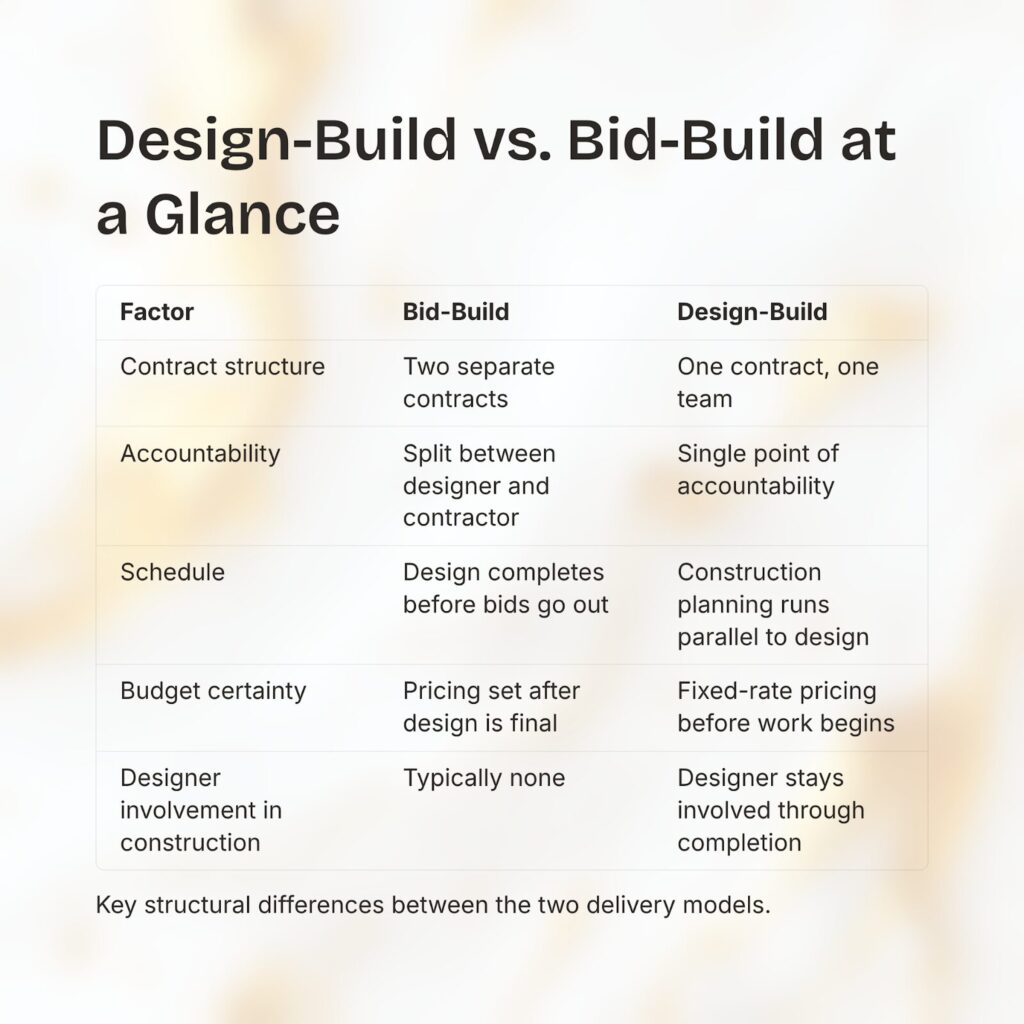
Most homeowners compare contractors, assuming they’re comparing the same type of service. They rarely are.
Bid-build is the traditional model. You hire an architect or designer separately; they produce plans, and multiple contractors bid to execute them. The designer and contractor are separate companies with separate contracts, separate incentives, and no shared accountability.
Design-build integrates both under a single contract and team. Your designer and construction crew are the same firm, working from a shared set of plans with a shared budget from day one.
For full-scope projects in this market, design-build is the preferred approach. In our experience, these projects move faster than the traditional design-bid-build model, largely because construction planning runs in parallel with design rather than after it.
When comparing bids, make sure you’re comparing equivalent service structures. A design-build quote that looks higher than a traditional contractor’s bid often includes design, materials management, and project coordination that the second quote doesn’t cover.
At Boss Design Center, our model means the designer who creates your kitchen concept stays involved through construction completion. There’s no handoff, and no ambiguity about who’s accountable.
What Does a Kitchen Remodel Actually Cost in Bethesda in 2026?
Kitchen remodeling costs in Bethesda reflect a market where full-scope renovations and high-end finishes are the norm. At Boss Design Center, our kitchen remodeling projects typically run $80,000–$250,000, reflecting complete, fixed-rate scopes with no allowances.
| Tier | Cost per Sq Ft | Typical Total (200 sq ft) | What’s Included |
|---|---|---|---|
| Basic | $150 to $200 | $30,000 to $40,000 | Cabinet refacing, new fixtures, cosmetic updates |
| Mid-range | $200 to $325 | $40,000 to $65,000 | New semi-custom cabinets, countertops, standard appliances |
| High-end | $325 to $450 | $65,000 to $90,000 | Custom cabinetry, premium countertops, layout changes |
| Luxury | $450 to $1,500+ | $90,000 to $300,000+ | Full structural reconfiguration, imported materials, top-tier appliances |
These figures are all-in: design, demolition, materials, labor, and permits. A bid that comes in significantly below these ranges is almost always excluding something: design fees, permit costs, or allowance placeholders that will inflate once work begins.
Why Labor Costs Are Running High Right Now
Labor in a Bethesda kitchen remodel typically runs 50 to 60 percent of the total budget. Skilled trade rates have climbed sharply in recent years. This context matters when evaluating bids. A quote that comes in well below market isn’t necessarily a bargain. It may reflect unlicensed subcontractors, deferred permitting, or allowances that will escalate once you’re committed.
Permits You’ll Need (and One Most Contractors Miss)
A full kitchen remodel in Bethesda (Montgomery County) requires multiple permits. A contractor who doesn’t discuss permitting upfront, or who makes you pull the permits, is a disqualifying signal. Unpermitted work can complicate a home sale and creates liability you’d be taking on personally.
| Permit Type | When Required |
|---|---|
| Building Permit | Structural changes: moving walls, adding openings |
| Electrical Permit | New wiring, panel changes, adding circuits |
| Plumbing Permit | Relocating sink, new dishwasher connection, gas line changes |
| Mechanical Permit | New range hood ducting, HVAC modifications |
| No Permit Required | Painting, cabinet replacement, countertop swap (cosmetic work only) |
When a Historic Area Work Permit (HAWP) Applies
If your home sits within a Montgomery County historic district and your kitchen project involves any exterior changes, new windows visible from the street, an addition, or modifications to the facade, you’ll also need a Historic Area Work Permit (HAWP). HAWPs are not required for interior-only work, so a typical interior kitchen remodel doesn’t trigger one.
That said, Bethesda and neighboring Chevy Chase include homes in designated historic districts, and if your kitchen expansion touches the exterior, it’s a requirement many contractors overlook. Missing it can result in stop-work orders even on otherwise fully permitted projects. A HAWP approval also doesn’t replace the need for a regular building permit. You’ll need both.
How to Read a Bid: Contract Terms and Red Flags

Get at least three written bids covering an identical scope before making any decisions. Maryland consumer protection guidance recommends this specifically for home improvement projects. Bids for the same kitchen can vary dramatically, and that gap almost always reflects scope differences, not contractor generosity.
Watch for allowances. An allowance is a placeholder amount in the contract for items you haven’t selected yet. For example: “$8,000 countertop allowance.” The problem is that once you’re mid-project and emotionally committed, you discover the countertops you want cost $13,000. That’s a $5,000 surprise after signing. At Boss Design Center, we don’t use allowances. Every material is selected before we write the contract, so the price you sign is the price you pay.
Down payment red flags. Maryland law caps the initial deposit at one-third of the total contract price. In practice, reputable firms ask for 10% or less upfront, with subsequent payments tied to project milestones. A demand at or near the legal ceiling is a sign the contractor lacks the working capital to fund early project stages independently.
Change orders. Even in a well-run project, unexpected conditions arise, particularly in older homes. Any legitimate change to scope, whether cost or timeline, should be documented in a written change order before work continues. A contractor who makes verbal agreements about extras mid-project creates accountability problems.
MHIC number in the contract. Maryland law requires the contractor’s MHIC license number to appear in the written contract. If it’s missing, that’s a legal violation and a sign of broader carelessness.
What Older Bethesda Homes Add to Your Budget
Bethesda’s housing stock skews old. The median construction year is 1970, and some neighborhoods include homes built in the 1920s and 1930s. That has direct implications for remodeling budgets.
In our experience, homes built before 1980 warrant a contingency of 15 to 25 percent on top of your base estimate. For homes in historic neighborhoods, 30 percent is more realistic.
The specific hazards that drive these contingencies:
- Lead paint (pre-1978 homes): Requires EPA-certified lead-safe work practices, adding both cost and timeline
- Asbestos (flooring, insulation, pipe wrap in homes built before the mid-1980s): Must be professionally assessed and abated before demolition
- Knob-and-tube wiring (pre-1940s homes): Cannot be safely buried under insulation and often needs full replacement
These aren’t rare findings in Bethesda’s older neighborhoods. They’re routine. A contractor who doesn’t raise these in an initial walk-through of a pre-1980 home hasn’t worked enough in this market.
Warranties and Your Legal Protections
Ask every contractor about their warranty terms in writing before signing. At Boss Design Center, every project includes a 5-year warranty on structural work and a 1-year warranty on all other work, from finishes and fixtures to cabinetry, plumbing, electrical, and beyond.
Beyond contractor warranties, Maryland gives you an important backstop: if a licensed contractor performs substandard work and won’t remedy it, you can file a claim with the MHIC and access the state’s Guaranty Fund for up to $30,000. This protection applies only to work performed by licensed contractors. Work done by an unlicensed contractor has no equivalent recourse. This is why the licensing check comes before anything else.
Key Questions to Ask Every Contractor
Before signing with anyone, get clear answers to these:
- Is your MHIC license current, and can I see it?
- Who is my single point of contact from design through completion?
- Do you use allowances in your contracts, or are all materials selected before pricing?
- Who pulls the permits, and is that included in the quoted price?
- What is your warranty on structural work? On finishes?
- How do you handle change orders?
A contractor who can’t answer these at the start of a conversation won’t handle the complexity of a full kitchen remodel any better.
Talk to Our Bethesda Team
Our Bethesda showroom at 7220 Wisconsin Ave is where projects take shape. You can review materials, work through design options with a designer, and see a photorealistic rendering of your finished kitchen before signing anything. Initial consultations are free. Our fixed-rate contracts mean the number we quote is the number you pay. No allowances, no surprises.
Schedule a consultation with our Bethesda team to discuss your kitchen project.