
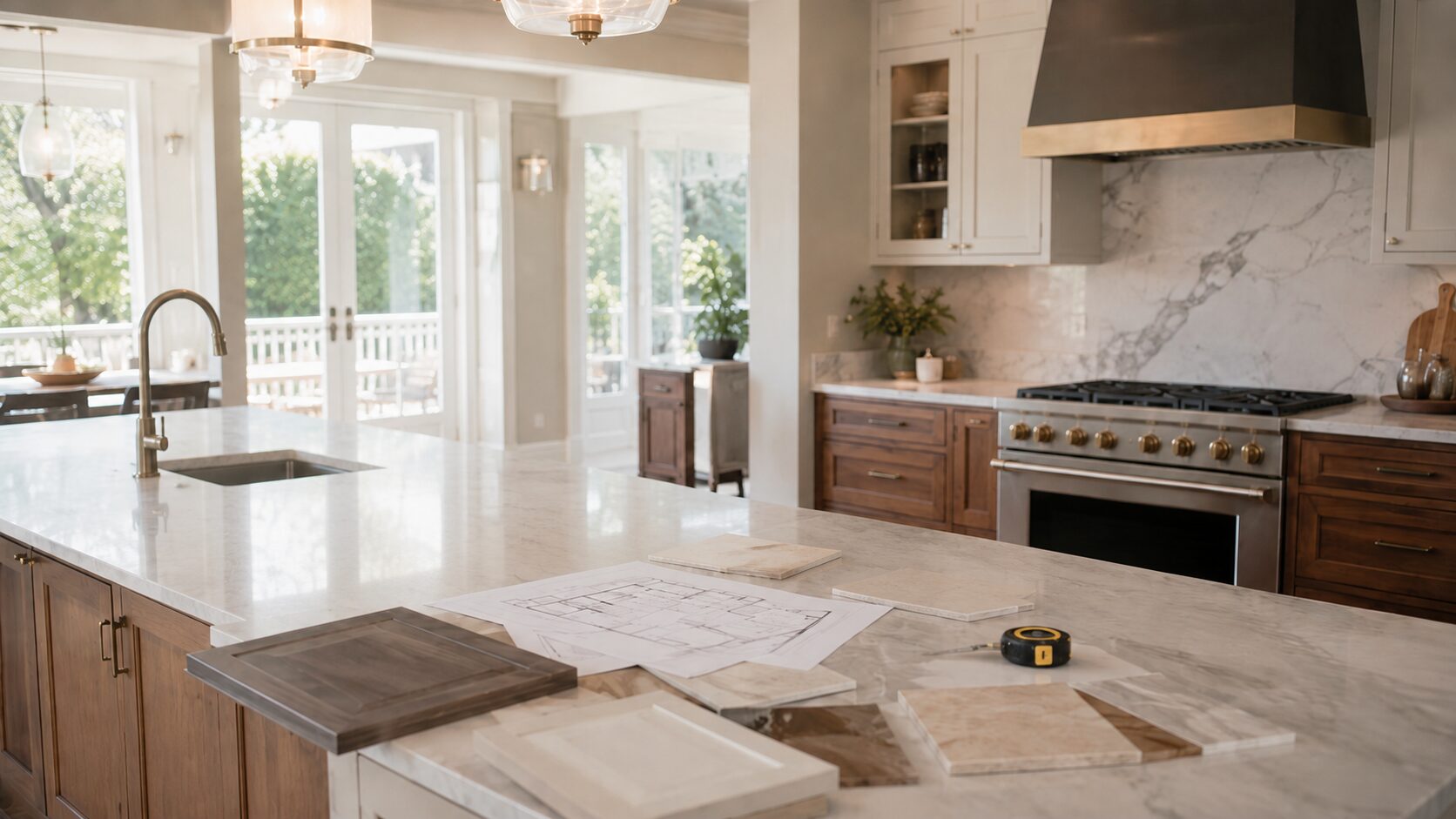
To choose a design-build firm in the DMV, start with the baseline: confirm the firm is licensed for your jurisdiction (Virginia, Maryland, or D.C. each have their own rules), carries general liability and workers’ compensation insurance, and can show you a portfolio and references for projects like yours. Every serious firm clears that bar, so the decision actually comes down to three questions most guides skip. How does the firm price the work, fixed-rate or estimate-based? Does the designer who creates your vision stay with you through construction, or hand you off? And does the firm know the permitting rules for your specific city or county?
We’re Boss Design Center, a design-build remodeling firm that has worked across Northern Virginia, Maryland, and D.C. since 2014, licensed in all three jurisdictions. This guide lays out how to evaluate any firm honestly. Where our own model is relevant, we’ll say so, but the framework works no matter who you hire.
The DMV is three separate jurisdictions
The DMV covers Washington, D.C., plus the Maryland and Virginia suburbs around it. That matters more than most homeowners expect, because contractor licensing, permitting, and consumer protections are set separately in each one. A firm can be perfectly legitimate in Virginia and not hold the license you need for a project in D.C. Your first job is to confirm the firm is properly credentialed in the jurisdiction where your home actually sits.
Verify the firm’s contractor license in your jurisdiction
Licensing is the one credential you can check yourself in a few minutes, and it’s the one most worth checking. Here’s what each jurisdiction requires and where to confirm it.
| Jurisdiction | License required | Key detail for a six-figure remodel | Verify it here |
|---|---|---|---|
| Virginia | DPOR Class A Contractor License | Class A covers single projects of $150,000 or more (thresholds were raised in 2025). Licenses go to the firm, which names a Qualified Individual. | DPOR License Lookup |
| Maryland | MHIC (Home Improvement Commission) license | Required for any residential work, with no dollar minimum. Since June 2024, MHIC contractors must carry at least $500,000 in general liability insurance. | MHIC Public Query |
| Washington, D.C. | Home Improvement Contractor (HIC) endorsement on a Basic Business License | Requires a $25,000 surety bond and liability insurance naming the District. Issued by DLCP (formerly DCRA). | DLCP Scout portal |
A few things to know as you check. In Virginia, the Class A threshold moved up in 2025, so a lot of older articles (and some contractor sites) still list the outdated $120,000 figure. Confirm the license is active, that the class covers your project’s value, and that the specialty designation matches your work. In Maryland, the license number is legally required to appear on your written contract, so if it’s missing, that’s a signal. In D.C., licensing now sits with the Department of Licensing and Consumer Protection, while permits and inspections are handled by the separate Department of Buildings.
For older homes, add one more credential to the list. If your house was built before 1978, any firm disturbing painted surfaces must be EPA Lead-Safe (RRP) certified. That applies to a lot of the DMV’s row houses and historic-district properties, so it’s worth asking about directly.
Confirm the firm’s insurance directly
Two coverages protect you: general liability, which covers property damage, and workers’ compensation, which covers crew injuries. Workers’ comp matters more than people realize. If a worker is hurt on your property and the firm doesn’t carry it, that liability can land on you.
The National Association of the Remodeling Industry (NARI) recommends verifying coverage by requesting the certificate directly from the insurer’s agent, not from the contractor, and asking to be named an additional insured on the policy. A firm that’s properly covered won’t hesitate to arrange that.
Look at the portfolio and talk to references
A portfolio tells you whether a firm has done work at your level and in a style you respond to. Look for projects comparable to yours in scope and price, not just attractive photos. Third-party recognition helps too. Awards like Best of Houzz, or membership in a body like the National Kitchen and Bath Association, are outside signals that the work holds up.
Then actually call references. Ask for at least three homeowners with projects similar to yours, and ask each one whether the final price matched the contract, whether the schedule held, and who their point of contact was day to day. That last question sets up the differentiator that matters most.
The three questions that reveal how a firm really works
Once a firm clears the credentials bar, the checklist advice runs out. These are the questions that separate a smooth project from a stressful one.
How does the firm handle pricing?
This is the single most revealing question you can ask, because the answer exposes how a firm operates. There are two basic approaches.
| Fixed-rate contract | Allowance-based pricing | |
|---|---|---|
| How the price is set | Built on complete, finalized specifications before you sign | Built partly on placeholder dollar amounts for materials you haven’t picked yet |
| When you select materials | Already chosen, so the price holds | Reconciled against the placeholder, and you pay the difference if your pick costs more |
| Where surprises come from | Genuine post-demolition structural issues or scope you add | The gap between the placeholder and what you actually choose |
| Your budget certainty | The quoted price is the price you pay | The contract total is an estimate that can climb |
The data backs this up. According to the 2026 Houzz & Home Study, more than a third of renovating homeowners (37%) went over budget in 2025, and the top reasons were higher-than-expected costs and pricier material choices than the budget assumed. Placeholder pricing is where a lot of that gap lives. When a firm fills your contract with low placeholder amounts, the quote looks competitive, then climbs once you pick real countertops, cabinets, and fixtures.
To be fair, a placeholder is a reasonable tool when a selection genuinely can’t be finalized before signing, like a long-lead custom item. The problem is placeholders set unrealistically low to win the bid. The way to protect yourself is to ask a firm to price your project on finalized selections, so there’s nothing to reconcile later.
At Boss Design Center, this is the core of how we work. We write fixed-rate contracts with no placeholder line items, select every material during the design phase, and source about 99% of materials in-house. The price we quote is the price you pay, with change orders only for post-demolition structural surprises or scope you choose to add. You also see photorealistic 3D renderings of the finished space before construction starts, so what you approve is what gets built. Whether you’re planning kitchen remodeling or a full renovation, that upfront certainty is the point.
Will my designer stay with me, or get handed off?
Many firms run a relay: a salesperson closes the deal, a designer draws the plans, then a project manager you’ve never met runs the build. Every handoff is a chance for your vision to get lost in translation.
Ask directly: who is my single point of contact, and does the person who designs my project stay involved through completion? The research backs up why this matters. A peer-reviewed study of 204 completed building projects by Franz and colleagues found that team integration and cohesion lead to lower cost growth and higher owner-rated quality, including a better handover experience. These were commercial projects rather than residential remodels, so treat it as directional, but the mechanism is intuitive. When the people who understand your project stay on it, fewer details fall through the cracks.
This is why we run a boutique model at Boss Design Center. The designer who develops your vision stays involved through construction. Our founder, Talha Gursoy, is an architectural designer with bachelor’s and master’s degrees in architecture from the University of Maryland, and the whole team is built around keeping design intent intact from concept to final walkthrough rather than passing you down a line.
Does the firm know my jurisdiction’s permitting?
Local process knowledge is where DMV experience earns its keep, and generic national guides never touch it.
In D.C., a property inside a historic district needs Historic Preservation Office review before a permit can issue. The D.C. Office of Planning reports that more than 95% of preservation applications clear an expedited review in days, but larger additions escalate to the Historic Preservation Review Board, which meets monthly and can add 30 to 60 days to your timeline. Work in Georgetown goes through the Old Georgetown Board instead. A firm that knows these pathways plans around the monthly docket. One that doesn’t can lose a month before a shovel moves.
Condos add a second layer. Beyond city permits, most condo and co-op renovations require board approval through an alteration agreement that sets construction hours, insurance and indemnity terms, and access logistics. Many buildings won’t let you file for permits, book the elevator, or mobilize trades until the board signs off, so sequencing matters. HOAs bring their own approval steps. Ask whether the firm has worked in your building or community and knows how its board operates. If your project is a bathroom remodeling job in a condo, that experience can be the difference between a clean start and weeks of delay.
We work across Georgetown, Capitol Hill, Cleveland Park, and the Maryland and Virginia suburbs, with showrooms in McLean and Bethesda where you can select materials in person. Knowing each jurisdiction’s process is part of the job here.
Understand what design-build gives you, and its one honest trade-off
Design-build puts design and construction under one roof, so a single firm is accountable from concept to completion. That structure removes the finger-pointing that happens when a separate designer and builder blame each other, gives you earlier cost visibility, and cuts the handoffs where projects stall. Design-build also tends to rate well with owners on satisfaction, which tracks with having a single line of accountability.
There’s a legitimate trade-off worth naming. Because the designer and builder are the same entity, there’s no independent party checking the builder’s work. On most residential remodels this is a fair exchange for the accountability and speed you gain, but on a very large or complex project, some owners choose to bring in an independent inspector for peace of mind. A good firm won’t get defensive when you raise it.
What a “good” warranty looks like on a remodel
Warranty terms tell you how confident a firm is in its own work. For new-home construction, the industry standard is often described as 1-2-10: one year on workmanship, two years on major systems, ten years on major structural defects. Remodels are different. A realistic baseline of good is a written one-year workmanship warranty, plus pass-through of the manufacturer warranties on your appliances, fixtures, and cabinets. The Federal Trade Commission lays out these same tiers.
Get the warranty in writing before you sign, and read what’s actually covered. At Boss Design Center, we back structural work for five years and all other work for one year, with manufacturer warranties passed through on the products we install.
Red flags to watch for
Some warning signs are consistent across the country. The Better Business Bureau ranked home-improvement scams the fifth-riskiest scam category of 2024, with a median reported loss of $1,800, and the FTC flags the same warning signs. Watch for these:
- Pressure to decide immediately, or “today only” pricing
- A demand for cash only, or full payment up front
- Door-to-door solicitation for a major remodel
- The contractor asking you to pull the permits yourself, which can leave you holding the liability
- Steering you toward a specific lender they have a relationship with
The FTC’s guidance is straightforward: never pay in full before work is done, never make the final payment until you’re satisfied, and pay by check or credit card so you keep a paper trail and some recourse.
Questions to ask in your consultation
Bring this short list to every consultation. The answers, side by side, will tell you more than any brochure.
- Are you licensed for my jurisdiction, and what’s your license number so I can verify it?
- Do you carry general liability and workers’ compensation, and will you name me as an additional insured?
- Is your pricing fixed-rate or built on placeholder allowances, and when does the price become final?
- Who is my single point of contact, and does my designer stay involved through construction?
- Have you handled permitting and board approvals in my city, building, or HOA before?
- What warranty do you put in writing, and what does it cover?
When you lay the criteria out honestly, the firms worth hiring separate themselves. A quality design-build firm is licensed where your home is, prices on real selections instead of placeholders, keeps your designer on the project, and knows how your jurisdiction actually works.
If you’re weighing a significant remodel anywhere in the D.C. metro area, contact us to talk through your project. We’ll give you a straight answer on scope, timeline, and a fixed price, whether it’s a single room or whole-house remodeling.
AUTHOR