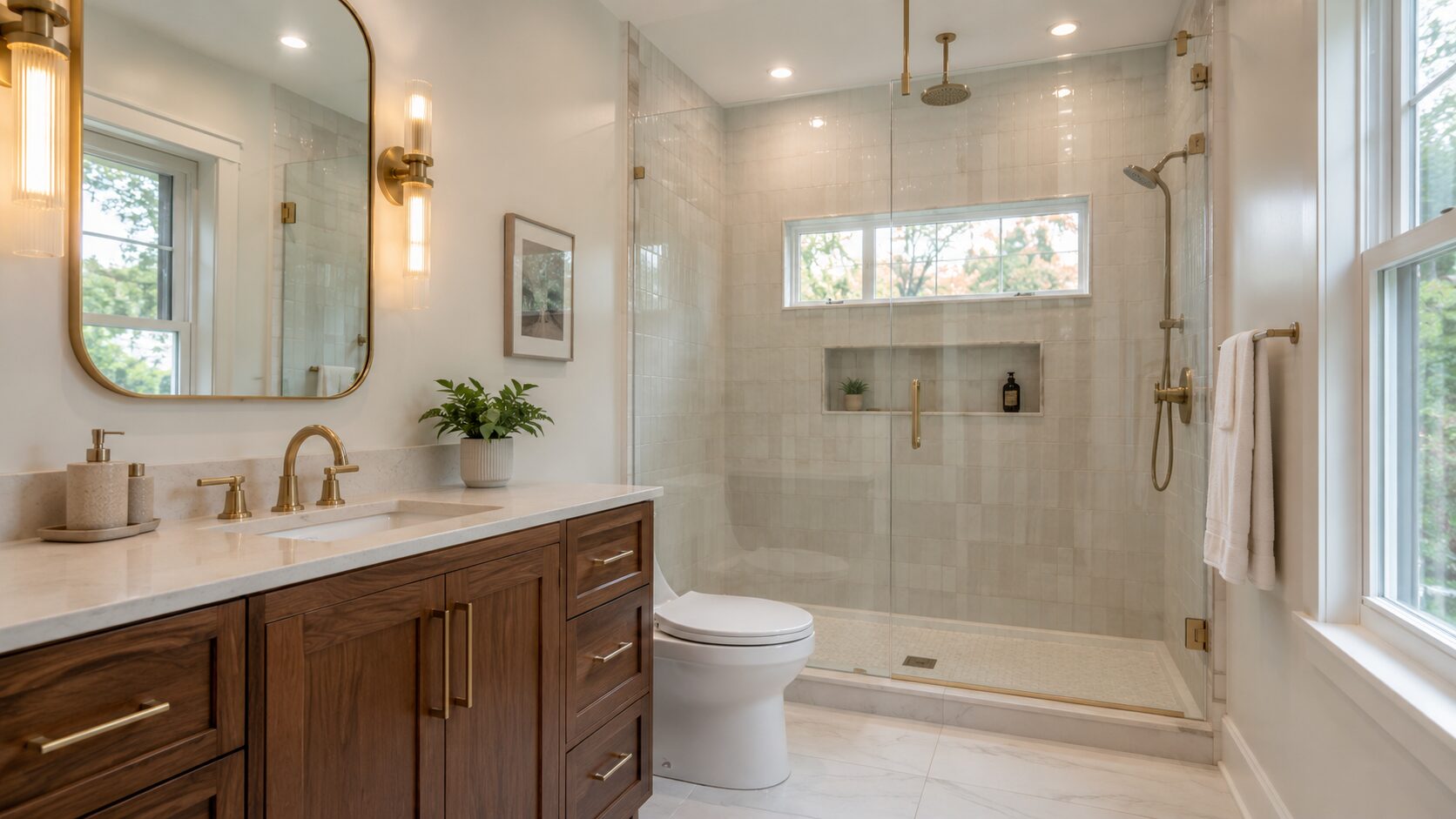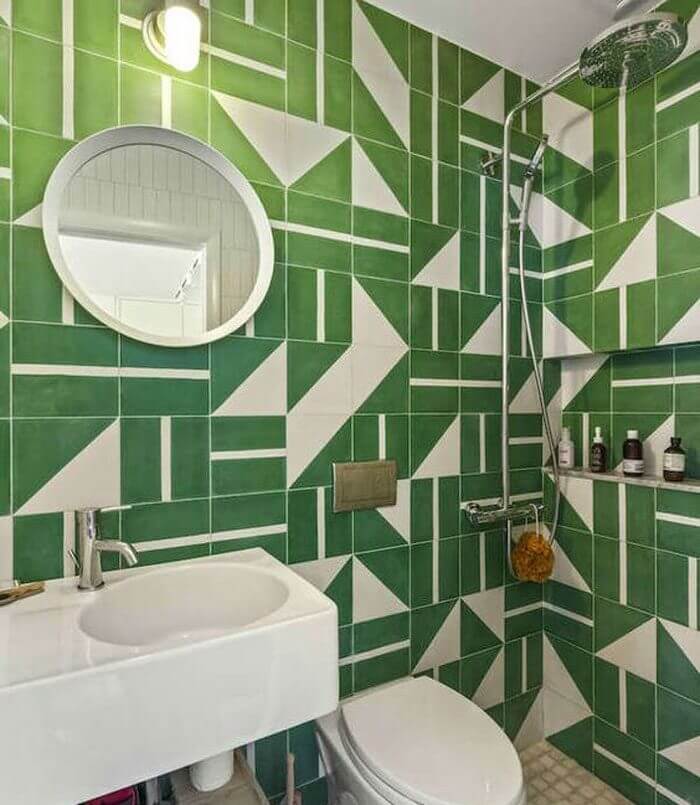

A luxury bathroom remodel in the Washington, D.C. metro area generally runs from the mid-$20,000s for a smaller high-end bath to more than $110,000 for a full primary-suite gut or a bathroom addition. The spread is that wide because three things move the number: the size of the room, how much you change structurally (plumbing, walls, layout), and the materials you select. At Boss Design Center, we’ve designed and built bathrooms across Northern Virginia, Maryland, and D.C. since 2014, and we quote a fixed price before construction begins, so the figure you see is the figure you pay. This guide breaks down what luxury actually costs by bathroom type and project scope, what pushes the price up or down, and the Virginia licensing details worth checking before you hire anyone.
What a luxury bathroom remodel costs in 2026
There is no single “luxury” number, because published sources are often describing very different projects. A 50-square-foot bathroom with high-end finishes is not the same job as a 100-square-foot primary bath that relocates every fixture and adds a freestanding tub, custom cabinetry, and radiant heat. Here is how the most credible national and regional data breaks down for 2026.
| Project tier | What it covers | Typical cost |
|---|---|---|
| High-end smaller bath (about 50 sq ft) | Premium finishes, custom cabinetry, possible minor structural change | $27,000 to $36,000 |
| Major primary bath remodel (100+ sq ft) | Full reconfiguration, relocated fixtures, premium fixtures and stone | $50,000 to $82,000 |
| Upscale primary bath, full custom (in footprint) | Frameless glass shower, soaking tub, stone double vanity, heated floors | About $81,000 |
| Upscale primary bath addition (new square footage) | Same luxury feature set, added onto the home | About $109,000 to $111,000 |
The cleanest “true upscale” benchmark comes from the Cost vs. Value report, which prices a standardized upscale bathroom remodel at roughly $81,600 nationally and about $81,000 in the Washington, D.C. area. That project is defined as expanding a bathroom to 100 square feet, relocating all fixtures, and adding a frameless glass shower with body sprays, a freestanding soaker tub, a stone double-sink vanity, custom cabinetry, upgraded lighting, and electric in-floor heating. An upscale bathroom addition, which adds new square footage rather than reworking an existing room, runs about $109,000 to $111,000.
Homeowner-reported spending tells a similar story at the top end. The 2026 U.S. Houzz and Home Study found that for major remodels of large primary bathrooms (100+ square feet), median spend was $30,000 and the top 10 percent of projects reached $75,000 or more. Lower “high-end” figures you’ll see online, often in the high $20,000s to mid $30,000s, usually describe a smaller bathroom. This Old House puts a high-end remodel of a 50-square-foot bath at $27,492 to $35,808, which works out to roughly $550 to $716 per square foot.
Bathroom remodel cost by room type
The single biggest reason quotes vary is the room itself. A powder room has no shower or tub to waterproof and tile, so it sits at the bottom of any range. A primary suite carries the most fixtures, the most square footage, and the most expensive finishes, so it sits at the top.
| Bathroom type | Size and scope | Cost range |
|---|---|---|
| Powder room / half bath | Smallest footprint, sink and toilet only, statement finishes | Lowest tier; below a full-bath remodel |
| Full or guest bath | About 50 sq ft, shower or tub-shower, premium finishes | $27,000 to $36,000+ |
| Primary / master bath | 100+ sq ft, double vanity, separate shower and tub, stone | $50,000 to $82,000 |
| Primary suite addition | New square footage with full luxury feature set | $109,000 to $111,000 |
A few notes on reading this table. Reliable cost data on high-end half baths is thin, because powder rooms are rarely the focus of standardized remodeling studies. What stays consistent is that a powder room, even one with a statement vanity and bold tile, sits well below a full bath, simply because there’s no wet area to waterproof and build. The full and primary bath figures come from the standardized and homeowner-reported sources above. The addition figure assumes you’re building out, not just rebuilding within existing walls.
What drives the cost of a high-end bathroom
Luxury isn’t only about expensive fixtures. The most expensive bathrooms are the ones that move the most. Once you understand where the money goes, the total starts to make sense instead of feeling arbitrary.
Layout and plumbing changes. Relocating the toilet, shower, or vanity means moving drains and supply lines, and that work runs into the thousands fast. Rough-in plumbing for a bathroom can range from about $3,000 to $20,000 depending on how many fixtures move and how far. Keeping the existing layout is one of the most effective ways to control a budget. Moving everything is one of the fastest ways to push a project into true luxury pricing.
The shower package. For most high-end bathrooms, the shower is where the budget is won or lost. A standard walk-in shower averages around $8,000, but a custom curbless shower with a bench, tiled walls and floor, and a glass enclosure can reach $20,000 or more. Tile choice alone swings widely: porcelain runs roughly $15 to $50 per square foot installed, marble $20 to $65, and glass tile $35 to $60, with premium glass reaching $180 per square foot.
Luxury features that stack. Individually, the signature touches are manageable. Together, they are what separate a standard remodel from a luxury one.
- Heated floors: $8 to $20 per square foot, or roughly $600 to $4,600 for most projects
- Frameless shower door: about $1,000 to $2,500, averaging near $1,400
- Steam shower (prefabricated unit): $2,800 to $7,100 before higher-end stone or tile
Vanities and tubs. A standard vanity install averages around $1,500, while a custom double vanity can run to $4,000 or more. Tubs span an even wider range. Bathtub replacement averages just under $6,000, freestanding tubs typically land between $2,000 and $3,000 for the fixture, and a statement clawfoot or designer soaking tub can exceed $10,000.
Labor. Skilled labor is a major part of any luxury bathroom, not a small line item. In one 2026 homeowner survey, nearly 40 percent of renovators said labor and materials made up roughly equal shares of their budget. Waterproofing, tile setting, and trade coordination are where craftsmanship shows, and they cost real money.
Cosmetic update vs. full gut renovation
The gap between a cosmetic refresh and a full gut renovation is often the difference between a $15,000 project and an $80,000 one. Both can use beautiful materials. What changes is how much comes out and how much gets rebuilt behind the walls.
A cosmetic update keeps the existing layout and most of the plumbing in place. You might replace the vanity, swap fixtures, retile, and repaint. A full gut takes the room down to the studs, often reworks the layout, relocates plumbing and electrical, replaces subfloor and waterproofing, and rebuilds from there. The gut is what allows a true spa-style primary bath: a larger shower where the closet used to be, a freestanding tub on a new drain line, radiant heat under new tile.
Our honest guidance to clients comes down to this. If the layout already works and the bones are sound, a high-quality cosmetic remodel can deliver most of the look for a fraction of the cost. If the room is cramped, the plumbing is dated, or you want a fundamentally different space, a gut renovation is the only way to get there, and the budget should reflect that from the start. We tell clients which one their project actually needs rather than quoting the cheaper version and discovering the rest later.
How location affects bathroom remodel cost in Northern Virginia
The D.C. metro is an above-average cost market, and Northern Virginia sits inside it. Regional price data from the federal government put the Washington-Arlington-Alexandria metro about 8.9 percent above the national average in 2024, and the area’s average hourly wage that year was $43.47 compared to $32.66 nationally. Those numbers help explain why the same bathroom usually costs more in Fairfax or Arlington than it would in other parts of Virginia.
That said, location is a real factor, not a giant multiplier. The standardized Washington upscale bathroom figure of about $81,000 sits very close to the national figure of $81,600. The safer way to think about it: Northern Virginia’s higher labor costs and material expectations tend to nudge a luxury bathroom toward the upper end of any national range, but scope, size, and finish selections still decide most of the total.
Virginia contractor licensing and what it means for your budget
Virginia ties contractor licensing directly to project value, which is useful to understand when you’re spending luxury-tier money. Any project over $1,000 requires a license from the Virginia Department of Professional and Occupational Regulation (DPOR), and the license class is set by the value of a single contract.
| License class | Single-project value | What it means for you |
|---|---|---|
| Class C | $1,000 to under $30,000 | Smaller jobs only; not sufficient for a full luxury bath |
| Class B | $30,000 to under $150,000 | Covers most luxury bathroom remodels |
| Class A | $150,000 and up, no cap | Required for the largest projects and multi-room scope |
For a luxury bathroom, this matters. A true high-end primary bath that lands around $80,000 to $110,000 falls squarely in Class B territory, and a larger gut, a suite addition, or a project bundled with other rooms can cross into Class A. The contractor you hire must hold at least the class that matches your contract value, and it’s worth verifying before you sign.
Local rules add another layer. In Fairfax County, smaller contractors (those working at the Class C level or below the Class C threshold) must hold a Fairfax County Home Improvement Contractor (HIC) license in addition to any state credential, and every contractor doing business in the county must carry the appropriate state license and a local business license. The practical takeaway for a luxury project: confirm the firm holds the correct DPOR class for your job size and is properly licensed to operate in your county.
We hold a Virginia Class A license, which carries no project-size cap, so our scope is never limited by licensing. We’re also licensed in Maryland and D.C., bonded and insured, and BBB A+ accredited, with multiple Best of Houzz awards for design and service.
What you actually get at this tier
When a bathroom budget reaches the upper ranges above, here is what that money typically buys in a primary suite:
- Double vanities with custom cabinetry and stone tops
- A large walk-in shower with multiple heads or body sprays and a frameless glass enclosure
- A freestanding soaking tub as the room’s focal point
- Heated floors and natural stone or large-format tile throughout
- A separate water closet for privacy
- Spa-inspired lighting and finishes designed as one cohesive space
These elements add up to a luxury figure because they’re rarely added piecemeal. They’re designed together, around a single vision, which is exactly where a design-build approach earns its keep. We establish the design first, select every material during that phase, and show you photorealistic 3D renderings so you can see the finished room before any demolition starts.
Do high-end bathrooms add resale value?
Here the honest answer matters. Upscale bathrooms recoup far less at resale than midrange ones. The pattern is consistent in the Cost vs. Value data.
| Project | Cost (Washington, D.C.) | Resale recouped |
|---|---|---|
| Midrange bath remodel | About $25,900 | 68% |
| Upscale bath remodel | About $81,000 | 40% |
| Upscale bath addition | About $109,000 | 32% |
A luxury bathroom is a lifestyle investment first and a resale play second. If you’re staying in the home and you’ll use the space every day for years, that math works in your favor. If your main goal is resale return, a midrange remodel recovers a much larger share of its cost. We’d rather tell you that up front than sell you a project that doesn’t match your actual goal.
How a fixed-rate, design-build approach protects your budget
At the luxury tier, budgets rarely break on the original quote. They break on the change orders that pile up after you sign, and those usually trace back to how the contract was written. Many remodelers quote a high-end bathroom using allowances, placeholder dollar amounts for items like tile, stone, or fixtures that get finalized after the contract. When your actual selections cost more than the placeholder, and at the luxury tier they often do, the price climbs.
We don’t use allowances. Because we design and build under one roof, you select every material during the design phase, so the price is locked before construction starts. Change orders happen only for structural issues discovered after demolition or for scope you choose to add. The designer who starts your project stays with it through completion, and you can see and touch every material at our showrooms in McLean and Bethesda, which is where luxury-tier decisions actually get made.
If you’re planning a high-end bathroom and want a number you can trust, we’d be glad to help. Learn more about our bathroom remodeling work, see how we handle bathroom remodeling in Virginia, or step back to a larger whole house remodeling vision. When you’re ready for a fixed-price design that fits your home and your goals, contact us to schedule a consultation.
AUTHOR