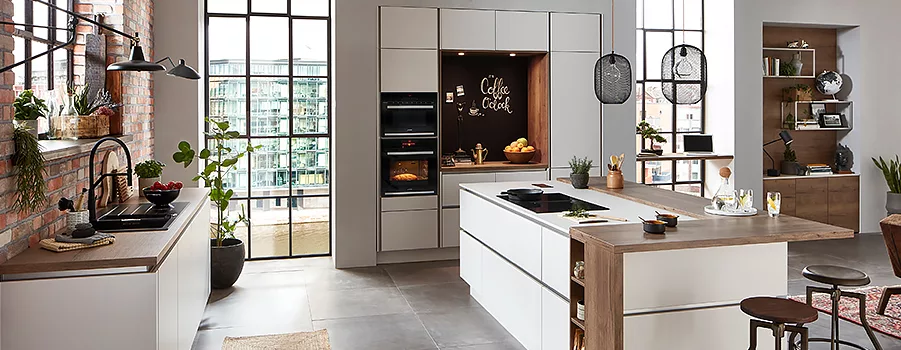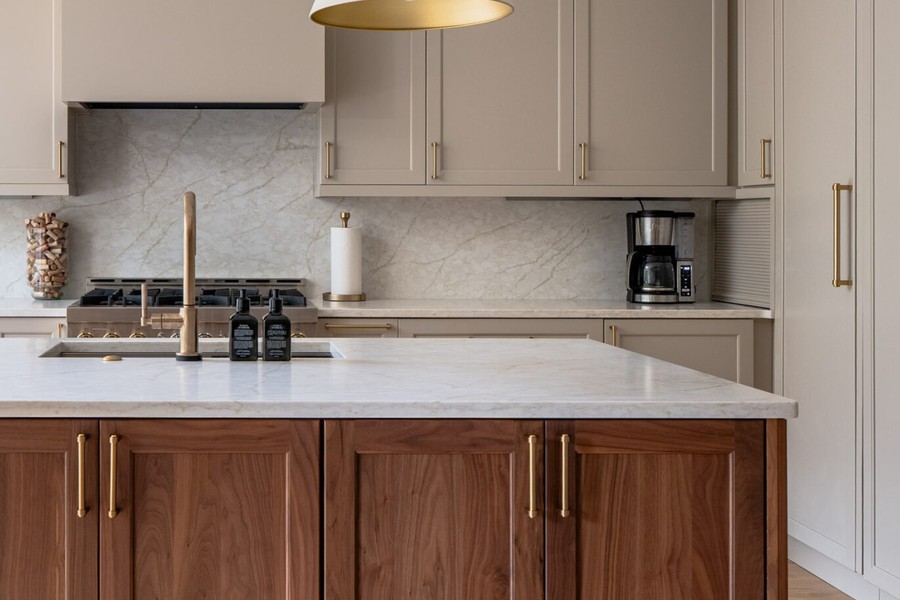
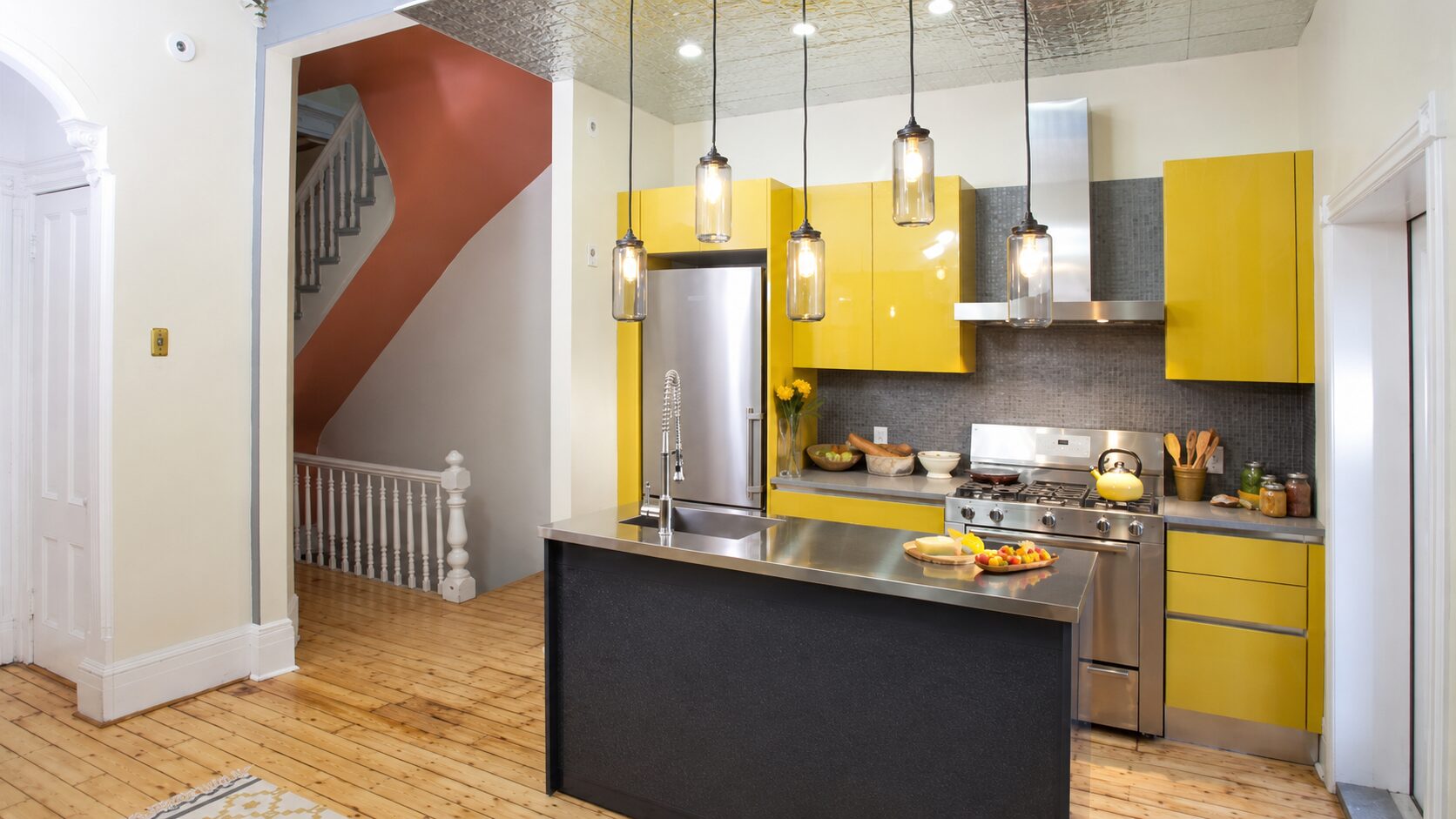
Cabinets are the most expensive part of a kitchen remodel. They take a larger share of the budget than any other single category. Citing the National Kitchen and Bath Association, Better Homes & Gardens puts cabinetry at 25% to 40% of a kitchen renovation. After cabinets, the money flows in a fairly predictable order: labor and installation, appliances, countertops, then flooring and the smaller finishes.
That is the short answer. The longer answer is the one that actually protects your budget, and it is the part most cost guides skip. At Boss Design Center, our kitchen remodels across the D.C. metro typically run $80,000 to $250,000, and we calculate that full number before construction starts, not as the project unfolds. Here is why that matters for this question: the line item that blows budgets most often is not on the price list at all. It is the gap between an early estimate and the final invoice. We will break down where every dollar goes, then explain why the cost of any single component is the easy part to plan for.
Where your kitchen remodel budget actually goes
Most full kitchen remodels follow a consistent cost hierarchy. The exact percentages shift with your choices, but the order rarely changes. The figures below are national, typical ranges meant to show proportions, not quotes for a specific kitchen.
| Component | Typical share of budget |
|---|---|
| Cabinets | 25% to 40% |
| Labor and installation | About 17% |
| Appliances and ventilation | About 14% |
| Countertops | About 10% |
| Flooring | About 7% |
| Lighting, backsplash, paint, plumbing fixtures | The remainder |
Forbes Home’s line-item model places cabinetry at 29%, labor at 17%, appliances at 14%, countertops at 10%, and flooring at 7%, with lighting, backsplash, wall work, and plumbing fixtures dividing the rest. The point is that “most expensive part” does not mean “only expensive part.” Cabinets lead, but labor and appliances are large enough to reshape the final number on their own.
It also helps to see this inside the bigger scope decision. Houzz’s 2026 kitchen research found that 52% of homeowners change their kitchen layout, yet 68% keep the room about the same size. A homeowner reworking function inside the existing footprint is playing a very different budget game from someone moving walls.
Why cabinets cost the most
Cabinets take up the most physical space in the room, they are the most visible surface, and they carry real manufacturing and finishing complexity. The NKBA’s cost guidance ties cabinet pricing to construction quality, materials, finishes, door styles, hinges, drawer glides, and storage options. Every one of those is a place where the price can move.
Convenience features add up faster than most people expect. Better Homes & Gardens reports soft-close hinges at $20 to $50 per door, rollout trays at $150 to $400 per cabinet, and dovetail drawers at $100 to $300 each. None of those feels expensive in isolation. Across a full kitchen, they compound.
Stock, semi-custom, and custom cabinets
The single biggest cabinet decision is the tier you build from. It sets your starting point before you choose a single finish.
| Cabinet tier | What it is | Relative cost |
|---|---|---|
| Stock | Pre-made boxes in standard sizes and a limited finish range | Lowest |
| Semi-custom | Standard construction with expanded sizes, finishes, and modifications | Mid-range |
| Custom | Built to your exact specifications, materials, and dimensions | Highest |
Real Simple notes that custom cabinetry can reach roughly $500 to $1,400 per linear foot, with materials driving a meaningful share of the difference. For homeowners who want the precision and modern aesthetics of European manufacturing, German cabinetry sits at the top of this range and is its own category of decision.
In our experience, smart cabinet spending comes down to where the cabinetry has to perform. Put the money into the daily-use zones and the focal walls, and stay more conservative everywhere else.
How much do countertops add to a kitchen remodel?
Countertops usually run about 10% of the budget, but they can climb quickly because the price is driven by more than the slab. Material, fabrication, edge profile, sink and appliance cutouts, and installation all factor in. Forbes Home reports countertop labor alone at $15 to $25 per square foot, on top of material and fabrication costs that climb with the stone you choose and the detail work involved.
Small fabrication choices carry real cost. Forbes notes that elaborate edges can add around $25 per linear foot, and rounded corners roughly $60 each. This is one of the easiest places to overspend without noticing, and one of the easiest to simplify when budget matters.
Where appliances fit in your budget
Appliances are typically about 14% of the budget, and they are the category homeowners notice most, because the numbers are easy to picture. Pricing spans a wide range depending on brand, type, and whether you are moving into built-in or professional-grade territory. The cost is not only the unit. Changing a gas, plumbing, or electrical hookup to accommodate a new appliance adds labor and can require updated permits.
For most full remodels, appliances still rank below cabinets unless the project moves firmly into high-end or fully built-in territory, at which point this line item can rival the others.
Labor and layout changes: the hidden budget accelerator
Labor is both a line item and a multiplier. On its own it is about 17% of the budget. But labor is what scope changes act on, and that is where projects climb fastest. Moving the sink, relocating the range, taking down a wall, or rerouting plumbing and electrical all expand labor, trade coordination, permitting, and inspection risk at the same time.
This is the bridge between component cost and project cost. Cabinets are the biggest single bucket, but a layout change is often the quieter accelerator, because it raises several costs at once rather than one. The D.C. metro adds to this. The Bureau of Labor Statistics reported a mean hourly wage of $43.47 in the Washington metro area versus $32.66 nationally in May 2024, and local construction and installation trades run above the national average. Labor-driven costs are simply higher here.
Flooring and finishes
Flooring usually sits below the top categories at around 7% of the budget, though material choice still swings the number. Vinyl and laminate sit at the affordable end, while tile and hardwood cost more depending on species and quality. The wildcard is what hides underneath. If demolition reveals a subfloor that needs replacing, that becomes an added cost no one planned for.
Lighting, backsplash, paint, and plumbing fixtures fill out the rest of the budget. Individually they are modest. Together they are worth selecting deliberately rather than at the end, when decision fatigue sets in.
Where to invest and where to save
You do not need everything at the top tier. The goal is to spend where it shows and lasts, and economize where it will not be missed. A few principles hold up across most kitchens:
- Keep the footprint when you can. Reconfiguring inside the existing layout is far cheaper than moving the sink, range, or walls. Most renovated kitchens stay roughly the same size for exactly this reason.
- Invest in cabinetry you touch daily. Hardware, drawer glides, and the boxes in your primary work zone earn their cost. Decorative upper cabinets on a far wall do not need the same investment.
- Consider semi-custom before full custom. If full custom is not in budget, semi-custom preserves most of the look and function for less. Where the existing boxes are sound, refacing fronts and updating hardware is a legitimate path. Houzz also found that 27% of renovators choose partial cabinet upgrades rather than full replacement.
- Simplify fabrication. Standard edges and fewer unusual cutouts cost less than highly customized stonework, with little visible difference in most kitchens.
The biggest savings rarely come from buying lower-cost materials. They come from locking decisions early, simplifying where detail will not be noticed, and avoiding scope you do not need.
The real budget risk is a contract that leaves the number open
Here is the part the cost hierarchy does not capture. The cost of any single component is knowable. Cabinets, countertops, appliances, all of it can be priced before a hammer swings. The danger is a pricing structure that does not require those numbers until you are already committed.
That structure usually goes by one word: allowances. An allowance is a placeholder amount written into a contract for something you will choose later. The American Institute of Architects describes an allowance as a stand-in figure used until the real cost is known, with the contract total then corrected by change order. An allowance is not a price. It is an assumption that gets trued up later, and it usually trues up.
The pattern is familiar. A contract lists a “$10,000 allowance for countertops.” You are halfway through the project, committed to the contractor, and the stone you actually want costs $15,000. The $5,000 difference is now yours. Multiply that across cabinets, tile, fixtures, and flooring, and you can see how a $200,000 project quietly becomes $230,000.
The data backs this up. Houzz’s 2026 Houzz and Home study found that 37% of homeowners exceeded their renovation budget, slightly more than the 35% who hit their target. Two of the most common self-reported causes were choosing higher-end materials than planned and expanding scope mid-project. Both happen when the real specifications get finalized too late, after the budget is already set on paper.
How fixed-rate pricing changes the math
This is the core of how we work at Boss Design Center, and it is why we can answer “what will this cost” with a single number. We select every detail during the design phase: cabinet style and finish, countertop material and edge, backsplash tile and grout, flooring, fixtures, paint, down to outlet covers. Because everything is chosen before construction, we issue a fixed-rate contract with no allowances. If the project is quoted at $200,000, it costs $200,000 when we finish.
Two things make that possible. As a design-build firm, we source roughly 99% of project materials ourselves, so the major components are priced through us rather than estimated. And every client selects their finishes in person at our McLean or Bethesda showrooms before we begin, which is how component costs get locked instead of guessed. The photorealistic 3D renderings we produce during design do the same thing visually: you see the finished space, and the number underneath it, before committing.
To be straight about it, no contract eliminates every change. Both the AIA and our own process recognize two legitimate reasons a cost can move: structural conditions discovered after demolition that must be fixed for safety or code, and changes you request beyond the original design. What a fixed-rate contract removes is the third and most common cause: the slow upward drift of allowances that were never real prices to begin with.
What a kitchen remodel really costs in the D.C. metro
National averages can mislead affluent homeowners in close-in Northern Virginia, Maryland, and D.C. The 2024 JLC Cost vs. Value report for Washington, D.C. put a major midrange kitchen remodel at $79,982 and a major upscale remodel at $158,530, well above many national internet figures. Those numbers line up much more closely with what a quality design-build project costs in this market, and with our own $80,000 to $250,000 range.
For a closer look at how this plays out locally, we break down kitchen remodel cost in McLean in detail, and our kitchen remodeling service walks through the full process. We work throughout Virginia,Maryland, and Washington, D.C.
Get a real number for your kitchen
Cabinets will likely be the biggest line item in your kitchen remodel, and now you know roughly where the rest of your budget goes. The more useful thing to know is that all of it can be priced before you commit, if your contractor is willing to do that work upfront.
That is what we do. Schedule a free consultation with Boss Design Center, and we will help you turn a rough budget into a real, fixed number for your specific kitchen, with every detail selected and priced before construction begins.
AUTHOR