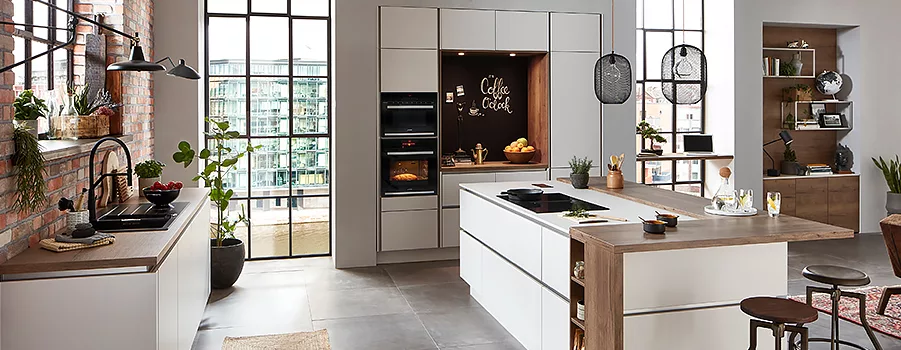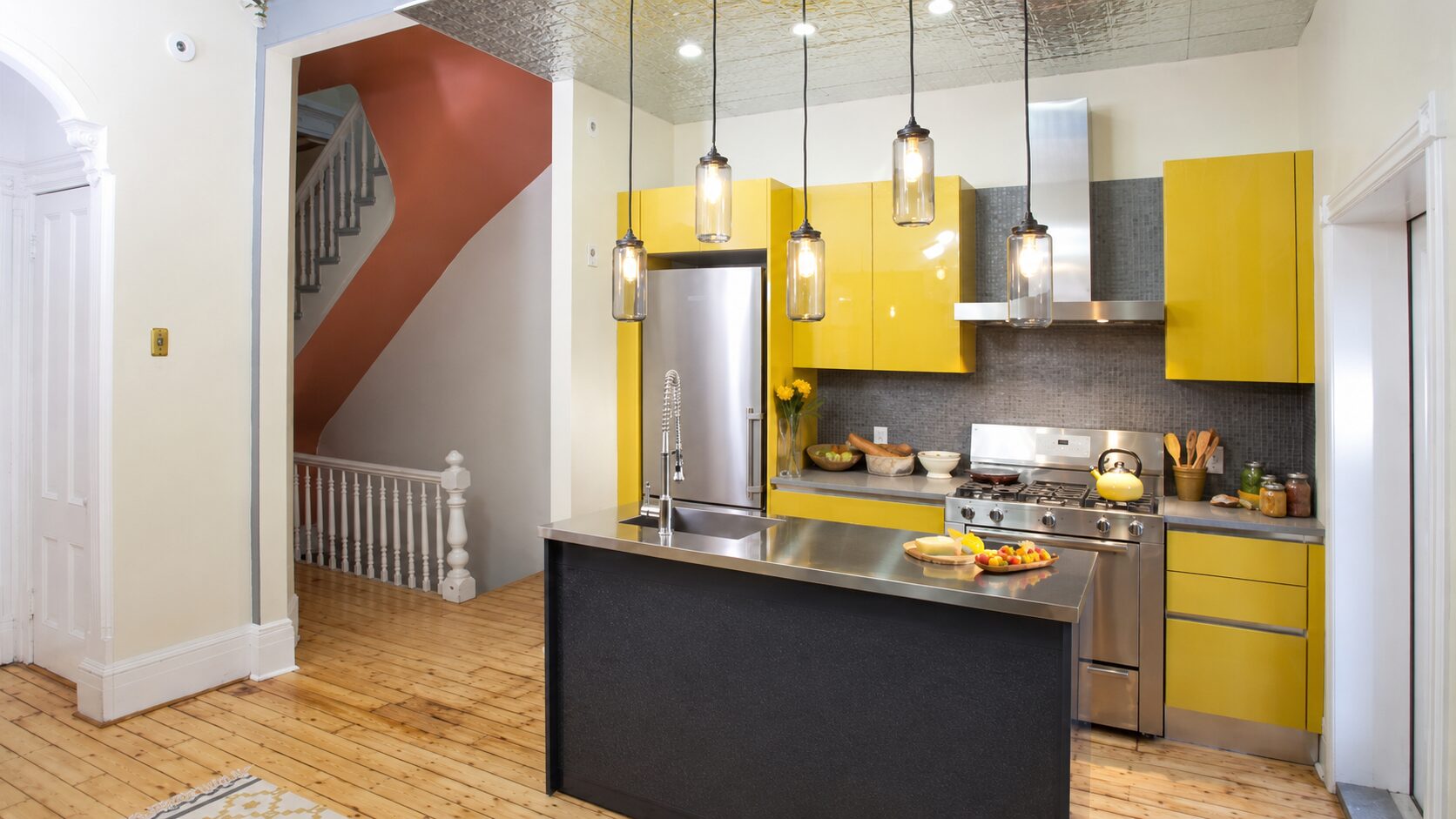
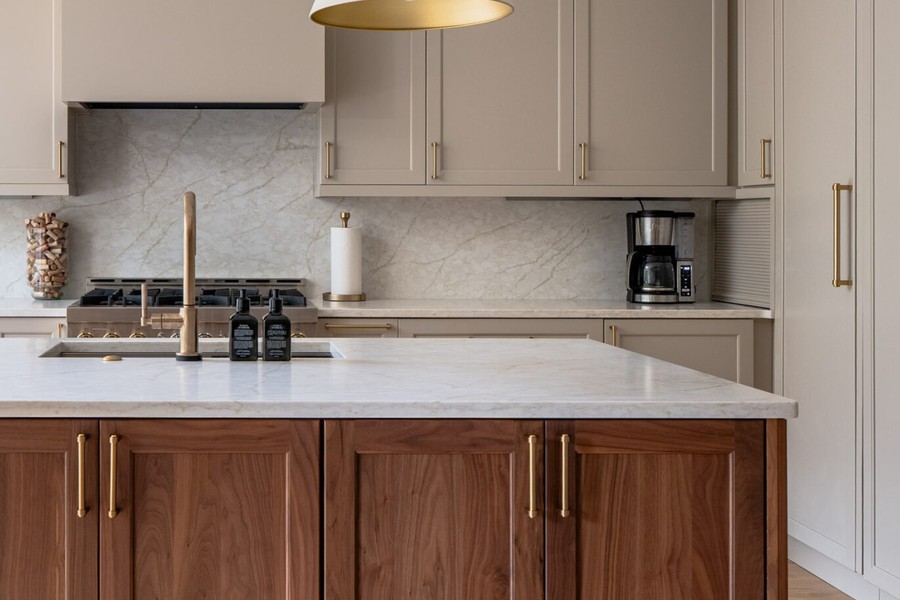
A 10×10 kitchen remodel runs about $10,000 to $25,000 nationally, with an average near $15,000. That number assumes a small kitchen, a roughly unchanged layout, and stock or semi-custom cabinets. It works as a benchmark for comparing quotes. It does not describe a custom, design-build kitchen in a high-cost market like the Washington, D.C. metro. At Boss Design Center, where kitchen remodeling is about 80% of our work across Northern Virginia and Maryland, our kitchen projects typically run $80,000 to $250,000. The difference between those two numbers comes down to scope, and this guide walks through exactly where it comes from so you can place your own project on the spectrum.
Here’s the short version. The “10×10” figure is a cabinet-industry estimating shortcut, not a price tag for a finished custom kitchen. Change the layout, upgrade the materials, move the utilities, or choose custom cabinetry, and you leave the benchmark behind. Below, we break down what a 10×10 kitchen actually costs at each quality tier, what drives the price per square foot, and why a custom renovation in McLean or Bethesda sits in its own bracket.
What “10×10 kitchen” actually means
A 10×10 kitchen is a 100-square-foot room, ten feet on each side. The term caught on because the cabinet industry uses it as a standard estimating template. Retailers and cost guides price a hypothetical 10×10 layout so shoppers can compare cabinet lines on equal footing. Consumer Reports has noted that retailer project estimates are commonly based on a 10×10-foot kitchen, and neutral cost guides treat it as the default small-kitchen reference point.
So the 10×10 number is a comparison tool for cabinetry and basic scope. It is not a quote for your kitchen, and it accounts for nothing beyond the basics: no layout changes, no structural work, no premium finishes. When you see “$15,000 for a 10×10 kitchen” online, you are looking at a baseline refresh, not a transformation.
10×10 kitchen remodel cost by quality tier
National cost guides sort a 10×10 remodel into three rough tiers. Here is what each one buys.
| Tier | Typical cost | What it includes |
|---|---|---|
| Basic | $7,500 to $15,000 | Painting or refacing existing cabinets, keeping current appliances, minor countertop or flooring updates, no layout change |
| Midrange | $15,000 to $30,000 | New stock or semi-custom cabinets, some new appliances, upgraded counters and flooring, same footprint |
| High-end | $30,000+ | Semi-custom or custom cabinetry, new appliances, higher-spec materials, possible layout or lighting changes |
The basic tier is real, but it depends on leaving most of the kitchen alone. According to Fixr, a 10×10 remodel can drop to around $7,500 when you paint or reface the cabinets and keep the existing appliances. Angi calls this a minor remodel: improving how the kitchen looks and works without changing the layout. Replace the cabinets, move a wall, or relocate the sink, and you climb the tiers fast.
Where the money goes in a kitchen remodel
Cabinets are almost always the single largest line item, and that one fact explains most of the gap between two kitchens of the same size. A 2026 breakdown from Angi splits a small kitchen budget roughly like this.
| Component | Share of budget |
|---|---|
| Cabinets | 28% |
| Labor | 18% |
| Appliances | 14% |
| Countertops and backsplash | 9% |
| Flooring | 7% |
| Lighting and electrical | 4% |
An older NKBA-derived worksheet published by HGTV puts cabinetry and hardware a little higher, at 29%, with installation at 17% and appliances at 14%. The sources line up: cabinetry eats close to a third of a kitchen budget, and more on higher-spec jobs. If you want to understand why one 10×10 kitchen costs $12,000 and another costs $40,000, start with the cabinets.
Why “same size” doesn’t mean “same price”
Two 10×10 kitchens can land tens of thousands of dollars apart because the cabinet tier alone moves the number that much. Here is the per-linear-foot cost by cabinet type, from Fixr’s 2026 national data.
| Cabinet type | Cost per linear foot (installed) |
|---|---|
| Stock | $100 to $300 |
| Semi-custom | $150 to $650 |
| Custom | $500 to $1,200 |
HomeAdvisor’s numbers track closely and note that custom cabinetry often costs two to five times as much as stock or semi-custom. A 10×10 kitchen holds somewhere around 20 to 25 linear feet of cabinetry, so the jump from stock to custom can swing the project by $15,000 to $25,000 on cabinets alone, before you touch anything else.
Cabinets aside, four things move the number most:
- Layout and structural changes. Moving a wall, relocating plumbing or electrical, or opening the kitchen to the next room adds labor, permits, and trade coordination.
- Material quality. Quartz versus laminate counters, hardwood versus vinyl flooring, high-end versus builder-grade fixtures. Each gap compounds across the room.
- Appliances. A professional range and a panel-ready refrigerator cost several times what a basic package does.
- Regional labor. For D.C.-area homeowners this is the big one, and it earns the section below.
Why a D.C. metro kitchen costs more than the national average
The Washington metro is a higher-cost market than the national average before any design decision enters the picture. The Bureau of Economic Analysis reports a 2024 regional price parity of about 109 for the Washington metro, meaning prices there run above the national norm. The Bureau of Labor Statistics put the average hourly wage in the Washington metro area at $43.47 in May 2024, against $32.66 nationally.
Higher labor and material costs flow straight into remodel pricing. Neutral local cost models already sit above the simple national 10×10 figure: Fixr estimates an average kitchen remodel of about $35,775 in Washington, D.C., and around $43,200 in Bethesda. Even an average kitchen here costs more than the national 10×10 benchmark suggests. A custom design-build kitchen costs more still.
What a custom design-build kitchen includes
Our kitchen projects typically range from $80,000 to $250,000, and that range buys a different product than a benchmark refresh. A design-build kitchen at this level is not nicer cabinets dropped into the same room. It usually means a layout redesign, custom cabinetry, premium countertops and flooring, new lighting, appliance installation, and all permits, planned and built by one team from concept to completion.
That work includes a full design phase before construction starts, photorealistic 3D renderings so you see the finished kitchen before we build it, and the same designer with you from the first consultation through the final walkthrough. For homeowners drawn to high-end European cabinetry, our German kitchens line sits in that custom tier. You can see the full scope of what we handle on our kitchen remodeling page.
We will be straight with you about which project you are actually planning. If you want a baseline 10×10 refresh, the national figures apply, and a smaller local contractor can handle that work well. If you want a custom kitchen designed and built as one integrated project in a high-cost metro, you are in the $80,000-plus range, and that number reflects scope, not a markup.
Allowances versus fixed-rate pricing
This is where homeowners get burned, and it matters more than almost any single material choice. Plenty of contractors win the job with a low headline number built on allowances. An allowance is a placeholder budget for something you have not chosen yet, say “$10,000 allowance for countertops.” Pick a slab that costs more, and premium slabs almost always do, and the price climbs mid-project. The low quote that won the job becomes a much bigger final bill.
We do not work that way. We select every detail during the design phase, cabinet finishes, countertop slabs, hardware, tile, lighting, before construction begins. Then we put it in a fixed-rate contract. Quote you $200,000 and the project costs $200,000 at completion. No allowances, no pricing decisions made on the fly, no surprise overages.
| Factor | Allowance-based pricing | Fixed-rate contract |
|---|---|---|
| Initial quote | Often lower | Reflects real selections |
| Selections made | Partly after signing | All before construction |
| Mid-project cost changes | Common | None |
| Final cost certainty | Low | Known upfront |
For homeowners who have already lived through a project that ballooned, the fixed-rate number is the most reassuring part of how we price. You know it before the first wall comes down.
What kitchen remodels return at resale
Kitchen remodels still pay back, but the return is stronger on modest updates than on major luxury overhauls. In the 2025 Cost vs. Value report for the South Atlantic region, a minor midrange kitchen remodel recoups about 109% of its cost, a major midrange remodel about 50%, and a major upscale remodel about 36%. The national pattern looks the same.
Resale is only part of the picture, though. The National Association of Realtors’ 2025 Remodeling Impact findings scored a kitchen upgrade a 10 out of 10 for homeowner satisfaction. Most of our clients are not remodeling to flip the house. They are building a space they will use every day for the next decade or more, and that kind of value rarely shows up in a resale percentage.
What’s moving kitchen costs in 2026
Cost pressure is still real in 2026, but it is easing rather than spiking.Verisk reported that total U.S. reconstruction costs, materials and labor included, rose 3.6% year over year through April 2026, down from 5.2% the prior period. The watch-outs are cabinet- and metal-heavy scopes. The National Association of Home Builders notes a 25% tariff on imported kitchen cabinets, furniture, and vanities in effect through January 2027, plus tariffs on steel and aluminum. Since cabinets are the biggest line item in most kitchens, those tariffs hit kitchen budgets harder than they hit most other remodels.
Frequently asked questions
Why is a custom 10×10 kitchen more expensive than the national average?
The national average assumes stock or semi-custom cabinets and an unchanged layout. A custom kitchen uses bespoke cabinetry, often changes the layout, and runs higher-spec materials throughout. Custom cabinets alone can cost two to five times what stock costs, and in a high-cost metro like D.C., labor adds further on top.
Do cabinets really cost 30 to 40% of a kitchen remodel?
Close to it. Most current breakdowns put cabinets around 28 to 30% of a kitchen budget, and the share climbs higher on premium projects where custom cabinetry is the largest single expense. Cabinets are the first place to look when you are comparing two quotes.
What’s the difference between an allowance and a fixed-rate contract?
An allowance is a placeholder budget for an item you have not selected yet, so your final cost depends on what you eventually pick and can rise mid-project. A fixed-rate contract locks the total after every selection is made before construction, so the quoted number is the final number.
Does a 10×10 kitchen remodel add value to my home?
Yes, though the return depends on scope. Minor midrange kitchen updates can recoup more than 100% of their cost at resale in the D.C. region, while major upscale remodels recoup a smaller share but deliver high day-to-day satisfaction.
How many linear feet of cabinets are in a 10×10 kitchen?
A 10×10 kitchen typically holds around 20 to 25 linear feet of cabinetry, though the exact figure shifts with the layout. That is why cabinet tier has such an outsized effect on the total: even a modest per-foot difference multiplies across the whole room.
Planning your kitchen remodel
If you are budgeting a kitchen remodel in Northern Virginia, Maryland, or D.C., start by figuring out which end of the spectrum you are on: a benchmark refresh or a custom design-build project. The national 10×10 numbers tell you what a refresh costs. For a custom kitchen, the honest range in this market starts higher, and the value lives in the design, the materials, and the certainty of a fixed price.
We are glad to talk budget openly. Schedule a free consultation at our McLean or Bethesda showroom, and we will give you a straight answer on what your project will cost and what that investment includes, before you commit to anything.