
When you gather bids for a kitchen or whole house remodel, you’ll run into two very different ways contractors price the work. A fixed-rate contract (also called fixed-price or lump-sum) gives you one total price for the whole project, agreed before construction starts. A cost-plus contract bills you for the actual cost of labor and materials as the job proceeds, plus the contractor’s fee, so the final number stays open until the work is done. The real difference between them comes down to one question: who carries the risk if the project costs more than expected?
That question has an honest answer, and it depends on your project. At Boss Design Center, we’ve been running design-build remodels across the D.C. metro area since 2014, mostly kitchens in the $80,000 to $250,000 range, and we price every job as a fixed rate with no allowances. So we have a clear point of view. But cost-plus is the right structure for some projects, and this guide weighs both fairly: how each one works, where your money is exposed, and the conditions where each one actually fits. Keep one thing in mind as you read. A fixed price only protects you if it’s built on a complete design. Without that, a “fixed” price is an estimate waiting to move.
What is a fixed-rate remodeling contract?
A fixed-rate contract sets one total price for a defined scope of work, agreed before construction begins. The contractor is paid that amount regardless of what the work actually costs to complete, which means the contractor absorbs the risk if materials or labor come in higher than planned.
A fixed price is only as reliable as the design behind it. When every selection is made and priced before you sign, the number is real. When the contract is full of placeholder figures for decisions you haven’t made yet, the “fixed” price will move once those decisions get made.
How allowances turn a fixed price into a moving one
This is where a lot of “fixed” quotes quietly come apart. Many contractors write allowances into the contract: placeholder amounts for items you’ll choose later. A contract might list a $10,000 allowance for countertops with the plan to pick them during construction. Then you’re midway through the project, committed to the contractor, and the counters you actually want cost $15,000. Now you’re facing a $5,000 increase you never budgeted for.
We reject that approach. On our projects, every detail is selected and priced during the design phase before construction starts: cabinets, countertop material and edge, backsplash tile and grout, flooring, fixtures, hardware, paint, down to the outlet covers. If we quote your kitchen at $200,000, it ends at $200,000. No allowances, no mid-project true-ups.
What is a cost-plus remodeling contract?
A cost-plus contract works the opposite way. You reimburse the contractor for the actual cost of labor and materials as they’re incurred, then pay an added fee on top for overhead and profit. The final total isn’t set at signing. It’s tallied from real invoices as the work gets done, which means the budget stays open until completion. According to Investopedia, that structure shifts most of the financial risk of overruns onto the owner, since actual costs are reimbursed whatever they turn out to be.
The fee (the “plus”) is usually structured one of two ways: a flat fixed fee agreed up front, or a percentage of the total project cost. Some cost-plus contracts add a guaranteed maximum price, or GMP, which caps what you’ll pay and hands any overage above the cap back to the contractor. Cost-plus is sometimes confused with time-and-materials billing. The difference is that time-and-materials charges pre-set hourly rates, while cost-plus reimburses documented actual costs plus the defined fee.
Done well, cost-plus is transparent. You see the real invoices, and an open-book contractor gives you line-item visibility into where your money goes. It also flexes easily when the scope changes, because a change simply adds to the reimbursable total instead of triggering a formal renegotiation.
Who carries the risk of going over budget?
This is the heart of the comparison. Under a fixed-rate contract, the contractor carries the risk of an overrun. Under a cost-plus contract, most of that risk sits with you, because you’re paying actual costs no matter where they land.
Overruns are common enough that this matters. In the 2026 U.S. Houzz & Home Study, the largest published survey of residential remodeling activity, 37% of homeowners exceeded their planned spend in 2025, while only 35% came in on budget. The most common reasons were higher-than-expected product and service costs, pricier materials than planned, and expanding scope mid-renovation.
Look closely at that list. Most of it is decisions and selections. Under a genuine fixed price, those choices are already made and locked before the contract is signed, so they can’t move the number. Under cost-plus, every one of them lands on your invoice.
The incentive problem with percentage-based cost-plus
Percentage-based cost-plus has a structural quirk worth understanding. When the fee is a percentage of cost, the contractor earns more in absolute dollars every time the project gets more expensive. Spending more raises their fee, so the pricing model gives them no built-in reason to hold costs down.
The federal government takes this seriously enough to ban the structure in its own contracting. Cost-plus-a-percentage-of-cost contracts are prohibited by federal law precisely because a fee that rises with spending removes the incentive to control costs.
To be fair, that criticism applies only to the percentage version. A cost-plus contract with a flat fixed fee removes the problem, because the fee doesn’t rise with costs. A guaranteed maximum price caps your exposure. Plenty of reputable contractors use cost-plus with a fixed fee or a GMP precisely to keep their incentives aligned with yours. If you’re weighing a cost-plus bid, the fee structure is the first thing to check.
Fixed-rate vs. cost-plus contracts at a glance
| Factor | Fixed-rate (fixed-price) | Cost-plus |
|---|---|---|
| How the price is set | One total price for a defined scope, agreed before construction | Actual costs billed as work happens, plus a fee |
| Final cost known before you sign | Yes, when the design is complete | No, the total stays open until completion |
| Who carries overrun risk | The contractor | Mostly the homeowner |
| Contractor’s cost incentive | Strong reason to control costs | Weak under a percentage fee, better with a fixed fee or GMP |
| Cost transparency | Priced against selected materials up front | Open-book, actual invoices as you go |
| Handles evolving scope | Works best when scope is fully defined | Flexes easily as scope changes |
| Best fit | A designable project where you want cost certainty | Undefined scope, major unknowns, or an owner managing the job |
When cost-plus is the right choice
Cost-plus earns its place when the scope genuinely can’t be pinned down before work starts. A few situations where it fits:
- Undefined or evolving scope, where the design is still taking shape as the project moves.
- Major structural unknowns, like a gut renovation of an older home where nobody knows what’s behind the walls until demolition.
- Volatile input prices, where locking a fixed number means paying for the contractor’s risk buffer whether or not it’s needed.
- Experienced owner-managers and investors who run their own design and sourcing and would rather pay actual cost than a built-in premium.
In those cases, the flexibility and open-book pricing of cost-plus are real advantages, and a fixed price would either be impossible to set honestly or would cost you a premium you don’t need to pay.
Why 2026 material and labor costs are part of this decision
There’s a legitimate argument for cost-plus grounded in current data. When input prices are moving, a fixed-price contractor has to build a contingency into the number to protect against increases. You pay for that buffer whether or not costs actually rise.
And prices are moving. Building material prices rose 3.5% year over year heading into 2026, the largest annual increase since early 2023, according to the National Association of Home Builders. The Associated General Contractors reports that the price index for nonresidential construction inputs climbed 3.6% over twelve months, with a majority of contractors naming materials costs as a top concern for the year, alongside worries about labor availability. In that environment, cost-plus lets an owner skip the risk premium and pay actual cost.
The trade-off is certainty. On a project you can fully design in advance, most homeowners we work with would rather know the exact number and let us carry the price risk. That’s a real decision with a cost on both sides, and it’s yours to make.
When a fixed-rate contract makes sense
A fixed-rate contract is the stronger fit when two things are true: your project can be fully designed before construction, and you want to know the total before you commit. That covers most kitchen remodeling projects and whole house remodeling with a clear scope, and most homeowners who aren’t planning to manage the job themselves.
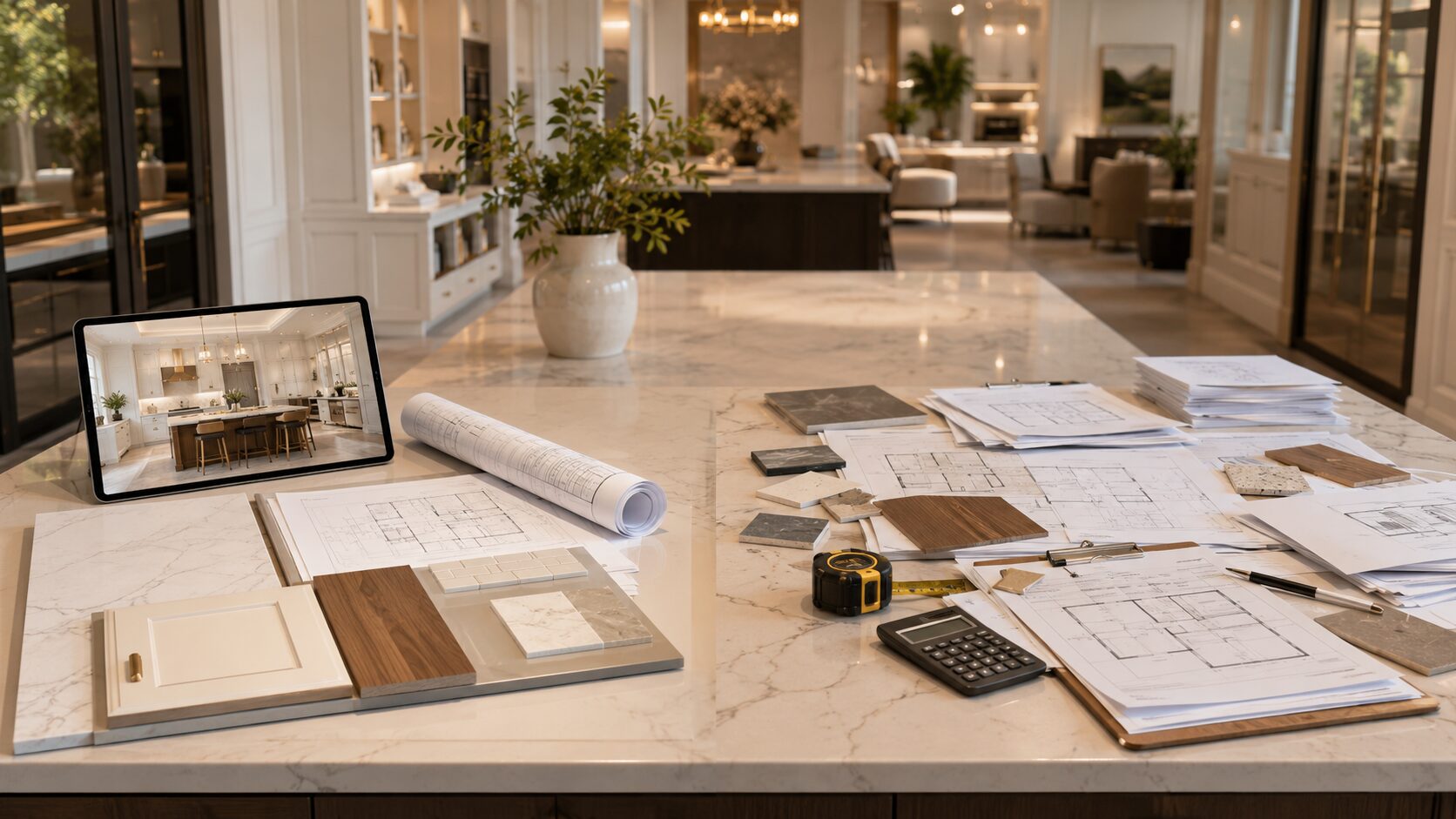
The condition that makes a fixed price real is complete upfront design. Every material and detail gets selected and priced during the design phase, and you see photorealistic 3D renderings of the finished space before anyone starts building. The price is set against the actual materials you chose, not placeholders. The design-build model matters here too. When the same team designs and builds, the designers understand construction costs and can price the job accurately from the start. That’s what makes a genuine fixed number possible.
An honest fixed rate isn’t a rigid one. On our projects, change orders happen in only two situations: structural damage we discover after demolition that has to be addressed for safety or code, and a change you request beyond the original agreed design. That’s what separates a real fixed price from a contract that pretends nothing will ever change, and it’s what makes the fixed number believable in the first place.
How to tell a real fixed price from a loose estimate
Whichever direction you lean, the questions you ask while comparing bids matter more than the label on the contract. Before you sign anything, ask:
- Are all materials and finishes selected and priced now, or are there allowances for decisions we’ll make later?
- What specifically triggers a change order, and how are change orders priced?
- Can I see the renderings, specs, or selections the price is built on?
- If it’s cost-plus, is the fee a flat amount or a percentage of cost, and is there a guaranteed maximum price?
- What does the payment schedule look like?
A contractor who can answer these clearly, and show you the selections behind the number, is giving you a price you can trust. A vague answer is a sign the number is likely to move.
Frequently asked questions
Is a fixed-price contract always cheaper than cost-plus?
Not necessarily. A fixed price may include a contingency to protect the contractor against rising costs, so on a smooth project cost-plus can come in lower. What a fixed price buys you is certainty: you know the number before you commit, and the contractor carries the risk if costs climb.
What are allowances, and why do they cause overruns?
Allowances are placeholder dollar amounts a contractor writes into a contract for items you haven’t selected yet, like a set figure for countertops or tile. When your actual selection costs more than the allowance, the price is adjusted upward mid-project. That’s a frequent source of surprise increases, and it’s why we price every selection before construction instead of leaving it for later.
Can a cost-plus contract have a maximum price?
Yes. A cost-plus contract with a guaranteed maximum price (GMP) caps the total you’ll pay. Costs above the cap become the contractor’s responsibility, which gives you some of the flexibility of cost-plus with a ceiling on your exposure.
What’s the difference between cost-plus and time-and-materials?
Both leave the final total open, but they bill differently. Time-and-materials charges pre-set hourly labor rates plus materials. Cost-plus reimburses the contractor’s documented actual costs and adds a defined fee for overhead and profit.
Get a fixed price you can plan around
If you’re planning a kitchen or whole house remodel in the D.C. metro area and you want to know the real number before you commit, we can help. We design every detail up front, show you photorealistic renderings, and quote a fixed rate with no allowances, so the price we give you is the price you pay. Visit a showroom in McLean or Bethesda, or contact us to start the conversation.