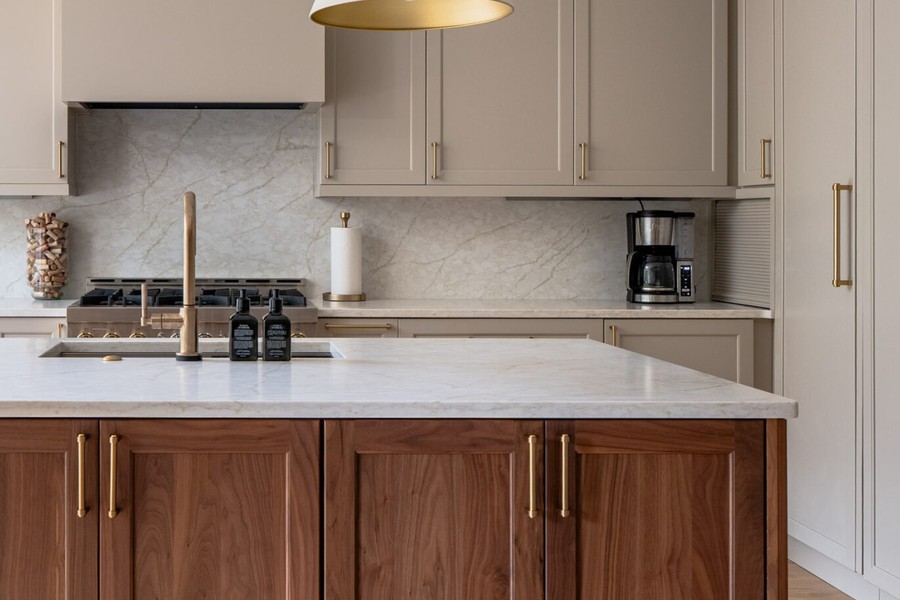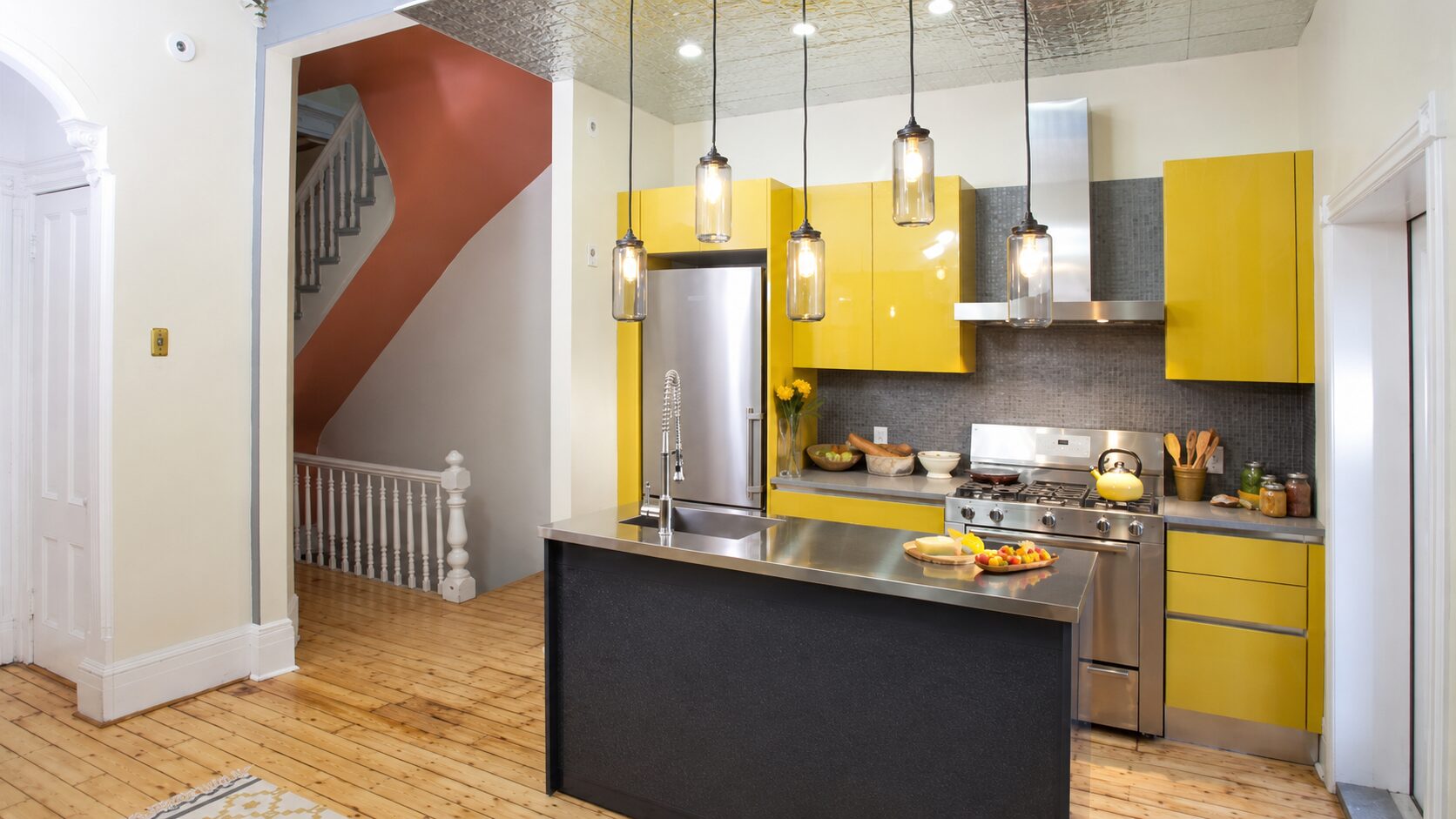
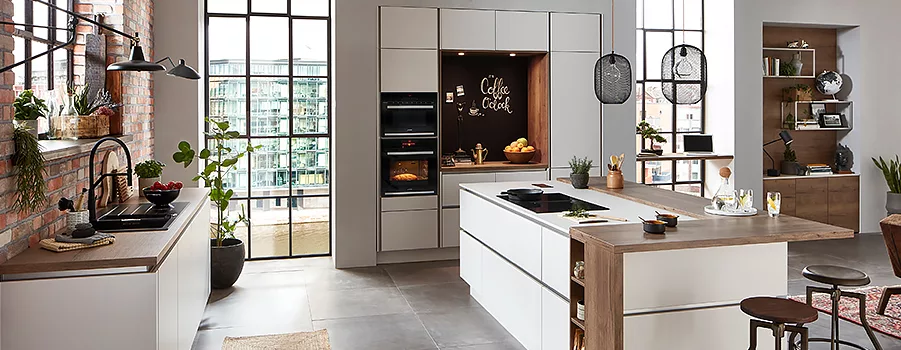
German kitchen cabinets and American kitchen cabinets differ at the construction level. German systems are frameless, with doors and hinges mounted directly to thick engineered side panels. American cabinets traditionally attach a solid wood face frame to the front of the box, and the doors mount to that frame. Nearly every other difference between the two systems, from storage capacity to door styles to hardware, flows from that one structural choice.
At Boss Design Center, we’ve installed German kitchen systems for homeowners across the DC metro area for over a decade, and we also design and build kitchens with American cabinetry. That means we have no reason to crown a winner. This comparison evaluates both systems the way we do in our own design consultations: on construction, materials, storage, hardware, style range, quality standards, cost, and lead times. If you want a full introduction to the category first, our guide to German kitchens covers what defines these systems in detail. This article stays focused on the head-to-head comparison.
German vs. American kitchen cabinets at a glance
| Criteria | German (frameless) | American (face frame) |
|---|---|---|
| Construction | No face frame; doors mount directly to 16mm or 19mm side panels | Solid wood frame of rails and stiles attached to the front of the box |
| Storage access | Full access to the interior; wider drawers per cabinet | Frame stiles narrow each opening by roughly 1.5 inches |
| Materials | High-density engineered board with laminate or lacquered fronts | Solid wood frames with plywood boxes (quality lines) or particleboard (stock lines) |
| Base | Adjustable plinth legs behind a removable toe kick panel | Integral wooden toe kick platform |
| Hardware | Soft-close hinges and full-extension drawers as standard | Often available, but frequently priced as upgrades |
| Style range | Handleless, slab-front, flush integrated appliances | Shaker, raised panel, inset, and the full traditional range |
| Customization | Modular sizing within an engineered system | Custom dimensions, stains, moldings, unusual configurations |
| Lead times | Ordered as complete packages from Germany | Domestic supply chains, shorter and more flexible |
| Cost | Premium end of the market; imported components carry tariff costs | Broad range, from stock lines to custom work that rivals German pricing |
How the construction methods differ
Every difference that follows traces back to how the cabinet box is built, so start here.
American face-frame construction
A face-frame cabinet attaches a solid wood frame, built from rails and stiles typically 1.5 inches wide and 0.75 inches thick, to the front of the cabinet box. Doors and hinges mount to that frame. According to Qualified Remodeler’s cabinetry materials guide, the frame adds horizontal rigidity and helps the box resist racking, which is the tendency of a cabinet to twist out of square. The face frame is also the traditional structure for inset doors, where the door sits flush inside the frame rather than overlaying it. If you want that classic inset look, the face frame is the structure that makes it possible.
German frameless construction
Frameless cabinets, also called full-access or 32mm system cabinets, have no face frame at all. Doors and hinges mount directly into thicker structural side panels, usually 16mm or 19mm. Removing the frame opens the full width of the cabinet interior. It also demands more precision: frameless boxes have a greater tendency to rack during handling, and the tight, consistent reveals between doors require careful clearance planning during design and installation. This is why German systems are engineered and machined as complete packages rather than assembled ad hoc on site.
Neither method is structurally superior across the board. Face frames resist racking better. Frameless panels are thicker and carry hardware loads directly. They’re different solutions to the same problem.
Which cabinets give you more usable storage?
Frameless construction yields more usable storage in the same footprint, and the mechanical reason is simple. Because a face frame’s stiles take up roughly 0.75 inches on each side of an opening, every drawer and pull-out in a framed cabinet is about 1.5 inches narrower than in a frameless cabinet of the same exterior width. Fine Homebuilding notes that frameless cabinets are easier to reach into and more spacious than face-frame cabinets.
You’ll often see this quantified as 10 to 15 percent more usable storage. Treat that number as an industry rule of thumb rather than a research finding. No independent study backs the exact figure. In our own installations, the gain is real, it’s concentrated in base cabinets, drawers, and roll-outs, and it matters most in smaller kitchens where every inch of drawer width counts. Wall cabinets with open shelving lose very little to a face frame.
Corner storage widens the gap. German systems typically use engineered corner pull-outs that bring the entire contents of a blind corner out to you. American cabinetry has traditionally answered with the lazy Susan, which 36 percent of renovating homeowners still chose in 2025 Houzz data. Both work. The pull-out systems yield more accessible storage from the same corner.
Cabinet materials: engineered panels vs. solid wood and plywood
German cabinet boxes are built from high-density engineered board, typically furniture-grade chipboard with laminate or lacquered fronts. American cabinetry traditionally pairs solid wood face frames with plywood boxes in quality lines, or particleboard in stock lines, with MDF common for painted door fronts.
Engineered panels get an unfair reputation in the US market, where “particleboard” often means the low-density material in flat-pack furniture. The high-density board in German systems behaves differently. As Woodworking Network explains, the random particle orientation in engineered panels, like the alternating grain in plywood, reduces dimensional change, and lamination adds further stability. Solid wood, for all its appeal, moves with humidity in ways engineered board does not. In the DC area’s humid summers, that stability is worth something.
Plywood and solid wood have their own genuine strengths: excellent screw-holding, easy on-site modification, and the ability to be sanded, stained, and refinished decades later. A laminated engineered panel can’t be refinished. If you damage it, you replace the component.
Plinth legs vs. the wooden toe kick
One material difference hides at floor level. German cabinets stand on adjustable plastic or metal plinth legs, commonly adjustable between 90mm and 150mm, concealed behind a removable toe kick panel. American cabinets traditionally sit on an integral wooden toe kick platform built into or under the box.
The plinth legs do three practical things. They make leveling on uneven floors faster and more precise. They create a service cavity under the cabinets. And they lift the cabinet box off the floor entirely, which matters if a dishwasher leaks or a pipe fails: water spreads under the cabinets instead of soaking into a wooden platform that supports your entire kitchen. A wooden toe kick that absorbs a slow leak can mean rebuilding cabinet bases. With plinth legs, you pop off a panel, dry the floor, and replace nothing.
What hardware comes standard on each system
German systems treat premium hardware as standard equipment. Soft-close hinges and full-extension drawer systems from manufacturers like Blum and Hettich are built into the base specification, and the numbers behind those components are substantial: Blum’s concealed hinges are engineered to withstand 200,000 opening and closing cycles, and its drawer systems carry load ratings of 40kg and 70kg with soft-close built in. Hettich’s double-walled drawer systems are certified to the European EN 15338 standard with capacities up to 80kg.
The same hardware is available on American cabinetry, and quality American manufacturers use it. The difference is how it’s packaged. On many American lines, soft-close and full-extension slides sit on the upgrade list, priced per cabinet. On a German system, the engineering is integrated from the start because the entire cabinet is designed around the hardware.
Style range: where American cabinetry pulls ahead
If your design direction is traditional or transitional, American cabinetry offers far more room to work. Face-frame construction supports the full range of raised panel, beaded inset, and applied molding details, plus custom stains, glazes, unusual dimensions, and one-off configurations that a modular European system can’t easily accommodate. This is where “custom” in American custom cabinetry earns its name.
The style data shows how much this matters to American homeowners. In the 2025 Houzz Kitchen Trends Study, Shaker doors remained the dominant choice at 61 percent, with flat-panel doors at 22 percent and rising. The 2026 study showed the same pattern holding, with Shaker at 58 percent and flat-panel steady at 22 percent. Most American kitchens are still traditional or transitional in style, and American cabinetry serves that majority well.
German systems dominate the other end of the spectrum. Handleless fronts with integrated pull channels, true slab doors with perfectly consistent reveals, and appliance panels that sit flush with the cabinetry so the kitchen reads as one continuous surface. About one in five homeowners now panel-front at least some large appliances, and that flush, continuous look is what German engineering was built for. You can approximate it with American cabinetry. Executing it at the same tolerance level is much harder.
Quality standards on both sides of the Atlantic
Both countries back their cabinetry with real performance standards, which is worth knowing when a salesperson implies otherwise in either direction.
American cabinets are certified under ANSI/KCMA A161.1, the only US performance standard for kitchen cabinets. KCMA certification testing cycles doors and drawers 25,000 times, loads shelves at 15 pounds per square foot for seven days, and loads mounted wall cabinets to 600 pounds. German manufacturers test under the RAL-GZ 430 quality standard, known by its Golden M mark, which covers durability, stability, safety, and emissions including formaldehyde and VOCs. On emissions, both systems sold in the US must meet the EPA’s formaldehyde standards for composite wood products, so neither side holds an air-quality advantage on paper.
Two honest caveats about frameless construction, both documented by KCMA in its analysis of cabinet durability: frameless cabinets typically show a higher initial failure rate on the base front joint loading test, and seamed slab doors can allow moisture to penetrate and swell the substrate if the machining isn’t watertight. Both are quality-control risks rather than inherent flaws, and they’re exactly why the manufacturer and installer matter more than the construction method. A precisely machined German system from an established manufacturer doesn’t have these problems. A poorly made frameless knockoff might.
What each system costs in 2026
German systems sit at the premium end of the market. In our projects at Boss Design Center, kitchen remodeling typically runs $80,000 to $250,000, and German systems fall on the higher end of that range due to the imported components and premium engineering. For context on the broader market, the 2025 Houzz study found the median spend on major remodels of large kitchens reached $72,000, with the top 10 percent of spenders investing $200,000 or more.
Two cost realities cut against the simple “German costs more” assumption:
- High-end American custom work is expensive too. Fully custom American cabinetry with premium hardware, inset doors, and furniture-grade finishes can match or exceed German system pricing. At equivalent quality levels, the gap narrows considerably.
- Tariffs now affect imported cabinet pricing directly. A 25 percent Section 232 tariff on imported kitchen cabinets took effect on October 14, 2025. Under the US-EU framework, the rate on EU-origin products, which includes German systems, is capped at 15 percent. A scheduled increase to 50 percent was delayed to January 1, 2027. If you’re weighing a German system, the tariff picture is a real budgeting factor and a reason to have current pricing in hand rather than relying on quotes from a year ago.
The good news for either direction: kitchen remodeling holds its value well. The 2025 Cost vs. Value Report found a minor midrange kitchen remodel recoups 112.9 percent of its cost nationally, the only interior project in the national top five.
Lead times and logistics
This difference deserves more weight than most comparisons give it.
A German kitchen is ordered as one complete, engineered package. Every cabinet, panel, and hardware component is manufactured to your kitchen’s exact dimensions in Germany, then shipped as a unit. That precision is a strength, and it comes with two logistical consequences. First, overseas manufacturing and ocean freight extend the timeline compared to domestic cabinetry, so the order date has to be locked early in the project schedule. Second, changes after ordering are costly or impossible. The measurement and design phase has to be right the first time, which is one reason we insist on finalizing every detail before contract in our own process.
American cabinetry runs on domestic supply chains. Lead times are shorter, replacement parts and change orders are easier to accommodate, and a damaged component mid-installation can often be remade in weeks rather than re-shipped across the Atlantic. If your remodel timeline is tight or your project has a higher chance of mid-course changes, that flexibility has real value.
Which system is right for you?
A German kitchen is the right fit if you:
- Want a modern, minimalist, or handleless kitchen with slab fronts and integrated appliances
- Value engineered precision, tight tolerances, and hardware that comes standard rather than as upgrades
- Want maximum usable storage from your footprint, especially in drawers and corners
- Can commit to finalizing every design decision before ordering, and can build the import lead time into your schedule
American cabinetry is the right fit if you:
- Love traditional or transitional styles: Shaker, raised panel, inset doors, decorative moldings
- Want custom dimensions, stains, or unusual configurations a modular system can’t deliver
- Prefer solid wood and plywood construction and the ability to refinish down the road
- Need shorter lead times or more flexibility for changes during the project
Plenty of homeowners are genuinely torn, usually because they like modern design but aren’t sure they want to go fully handleless. That question gets answered in a design conversation rather than on a spec sheet, and it’s easier to have in person. Our partner for German systems is Nobilia North America, whose parent company is Europe’s largest kitchen manufacturer, and we display both German and American cabinetry side by side in our showrooms so you can open the drawers, feel the hardware, and compare the two systems directly.
Compare both systems in person
At Boss Design Center, we design and install both German kitchen systems and American cabinetry across Northern Virginia, Maryland, and Washington, DC. Every project starts with a free consultation. You’ll get photorealistic 3D renderings, so you see exactly how your kitchen will look in either system before committing, and a fixed-rate contract, so the price you sign is the price you pay. Visit our German kitchens page to learn more, or stop by our McLean or Bethesda showroom to put your hands on both systems and decide which one belongs in your home.