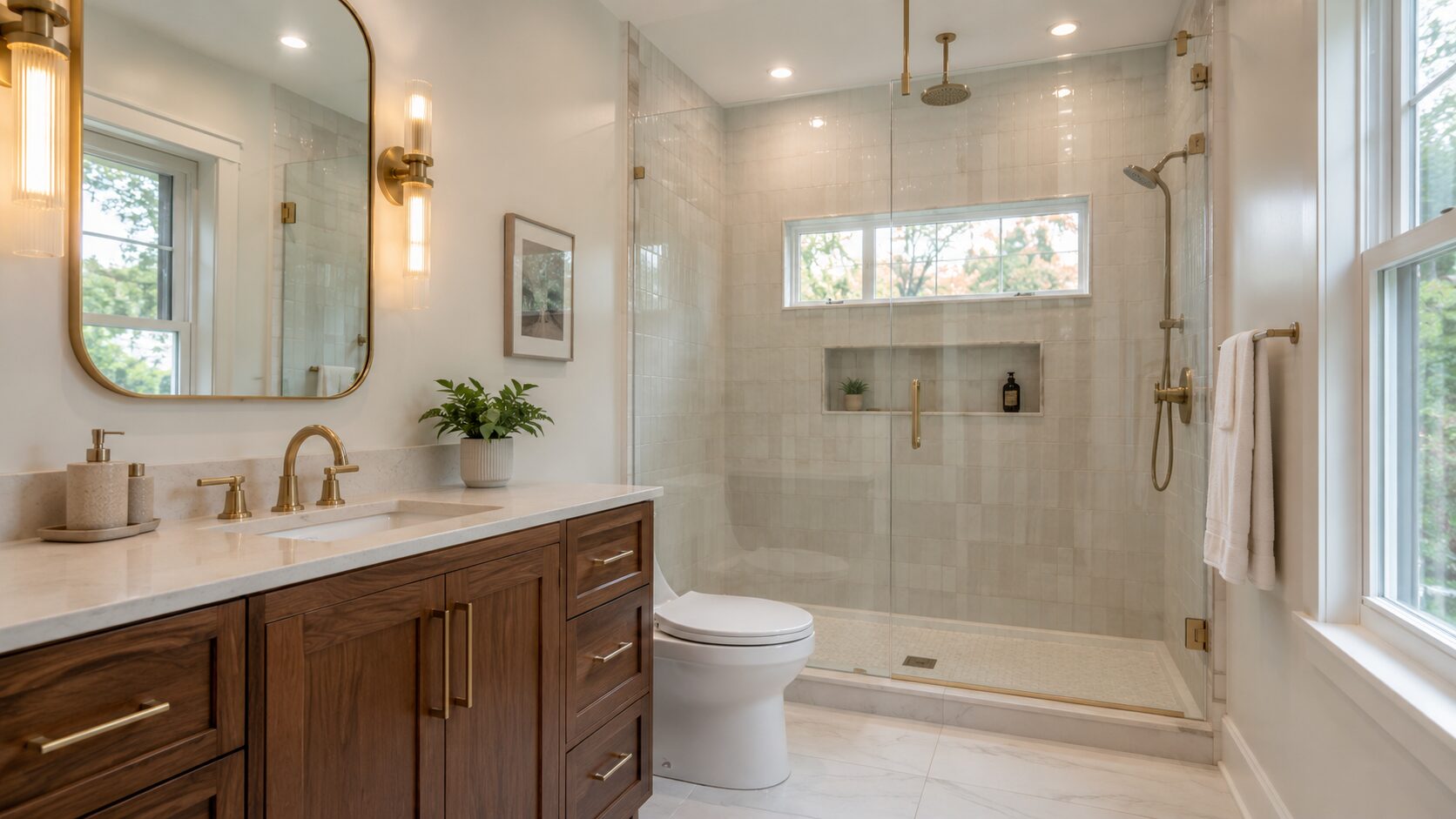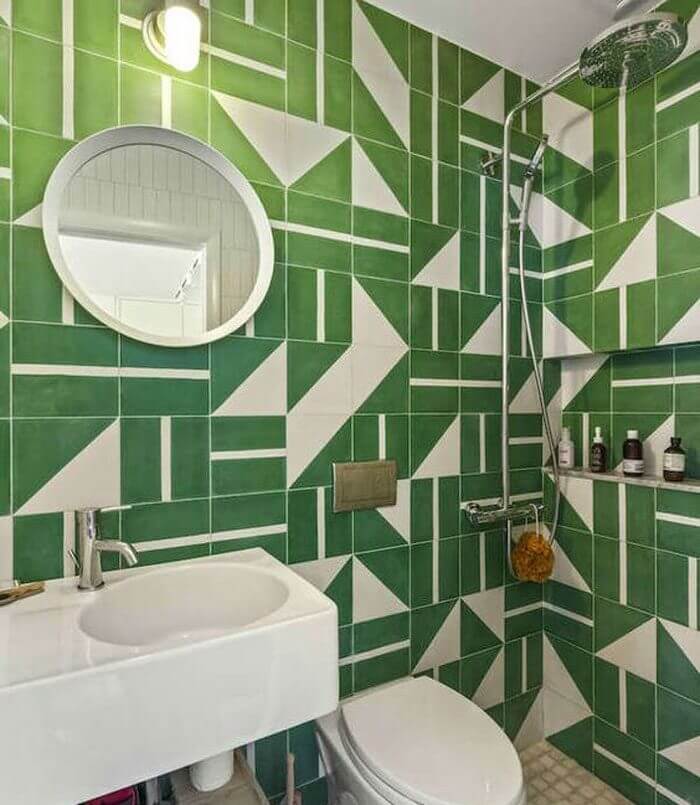

Labor is the largest cost category in a bathroom remodel, commonly running 40% to 65% of the total. The most expensive single assembly in the room is the shower, which This Old House puts at just over $8,000 on average nationally, ahead of plumbing, cabinetry and tile. In the Washington market a standardized midrange bathroom runs $25,936 and an upscale one $80,994, both marginally below the national figures. Either way you answer the question, your money goes to skilled work more than to the products you pick out.
At Boss Design Center we’ve been designing and building bathrooms across Northern Virginia since 2014, and the expensive parts of the job are almost always the parts nobody sees once it’s finished. Drain and vent lines, supply lines, the waterproofing behind the tile, the exhaust fan, and the subfloor underneath all sit behind finished surfaces. They’re also the items a bid can leave open as an allowance instead of a selected, quoted number, which is why two estimates for what looks like the same bathroom remodel in Virginia can be tens of thousands of dollars apart.
Where the Money Goes in a Bathroom Remodel
This Old House published per-component national averages for a full bathroom remodel in July 2026. These are broad national averages rather than Northern Virginia quotes, and the categories overlap, so they don’t add up to a project total. What they show clearly is the order of magnitude between components.
| Component | National average |
|---|---|
| Complete shower installation | $8,044 |
| Plumbing | $5,545 |
| Cabinetry | $2,929 |
| Insulation and drywall | $2,338 |
| Tiling | $1,326 |
| Bathtub | $1,123 |
| Flooring | $1,114 |
| Toilet | $467 |
| Electrical | $456 |
| Tub faucets | $423 |
Look at the gap between the top two lines and the bottom four. The shower and the plumbing together account for more than the toilet, the tub, the tub faucets, the flooring and the electrical combined. Homeowners tend to budget in the opposite direction, because fixtures are the part of the project you can shop for and hold in your hand. A more expensive faucet costs more than a plainer one, and that’s the end of it. A relocated drain changes demolition, framing, waterproofing, tile and inspections all at once.
How much of your total goes to labor depends on how much of that hidden work your project requires. Angi puts labor at roughly 40% to 65% of a full bathroom remodel, and This Old House’s shower analysis lands in a similar band at 40% to 60% for shower work specifically. A bathroom that keeps every fixture where it is will sit at the low end. A bathroom that moves the toilet and turns a tub alcove into a curbless shower will sit at the high end.
Why Moving Plumbing Fixtures Raises the Cost So Much
Relocating a fixture is the single decision most likely to change your budget, and it’s usually made during design, when it feels like a drawing choice rather than a cost. The published benchmarks give you a sense of the scale.
| Change | Reported cost |
|---|---|
| Floor plan change requiring plumbing and electrical rework | About $5,000 |
| Moving a fixture three feet or more | $500 to $1,000 |
Those figures come from NerdWallet and Angi. They’re national planning benchmarks rather than Northern Virginia trade pricing, so use them to understand the size of the decision. They aren’t a quote for your bathroom.
The cost climbs because moving a fixture means opening the floor to reach the drain. If your bathroom sits over a crawlspace or an unfinished basement, a plumber can work from below. If it sits on a concrete slab, the slab has to be cut and repoured, and nobody publishes a credible figure for what that adds, so a contractor quoting that difference without having seen your floor is guessing at it. Once the drain moves, the vent line that serves it has to follow, the supply lines get rerun, the framing gets patched, the subfloor gets rebuilt, and the waterproofing and tile go back over all of it.
What Virginia’s Plumbing Code Requires
Virginia adopted the 2021 International Plumbing Code as part of its current building code, effective January 18, 2024. Section 704.1 sets the minimum slope a horizontal drain line has to maintain.
| Horizontal drain size | Virginia minimum slope |
|---|---|
| 2.5 inches or less | 1/4 inch per foot |
| 3 to 6 inches | 1/8 inch per foot |
| 8 inches or larger | 1/16 inch per foot |
That requirement matters more than it sounds like it should. A drain line has to fall continuously toward the main stack, so every additional foot of horizontal run uses up vertical space inside your floor. Move a toilet far enough from the stack and there may not be enough depth left between the joists to keep the required fall. The fix at that point is a different route, a dropped ceiling in the room below, or a raised floor above, and the relocation stops being a plumbing cost and becomes a structural one. That’s the kind of problem worth solving on paper during design, where the answer is a drawing revision, instead of on site, where it’s a change order.
Why the Shower Costs More Than Anything Else in the Room
A custom shower is a stack of separate systems, each one built correctly and in the right order, and each one carrying its own cost. The tile goes on last, and it isn’t where most of the money goes.
| Custom shower element | National installed benchmark |
|---|---|
| Custom shower pan | $1,500 to $3,000 |
| Waterproofing system | $1,500 to $2,000 |
| Tile floor installation | $2,000 to $2,500 |
| Shower door | $600 to $900 |
| Drain | $400 to $500 |
| Shower head | $200 to $500 |
| Entire custom shower remodel | $8,500 to $10,000 |
These come from This Old House’s 2026 shower cost analysis. The scopes overlap in places, so the individual lines won’t sum neatly to the total, and a frameless glass enclosure or a stone slab surround sits well above the door and tile figures shown here. For a closer look at what happens to these numbers at the top of the market, we cover high-end bathroom remodel costs separately.
What a Waterproofed Shower Actually Includes
Waterproofing is the line homeowners recognize least and the one that matters most, because it’s the only part of the assembly whose failure destroys everything built on top of it. A modern shower uses a bonded sheet or board membrane over backer board, with every seam and inside corner banded, and a sealed connection where the membrane meets the drain. The performance standard those membranes have to meet is ANSI A118.10, published by the Tile Council of North America, whose installation handbook is the reference a qualified tile setter works from.
Design choices change what that assembly costs. A curbless shower, meaning one with no step to walk over, requires recessing or sloping the subfloor toward a linear drain. That means more framing and more labor before a single tile gets set. More of our clients ask for curbless showers every year, and most of them expect it to cost less because the finished room looks simpler. It usually costs more.
Why a Small Bathroom Does Not Cost Proportionally Less
A bathroom half the size of another bathroom doesn’t cost half as much, and that catches most homeowners off guard. The work doesn’t scale with the floor area.
The clearest evidence is the benchmark scope in the 2025 Cost vs. Value report from JLC and Zonda. Their midrange bathroom project is defined as an existing 5-by-7-foot bathroom, which is 35 square feet, and it includes a tub and surround, a pressure-balanced shower control, a toilet, a vanity with counter and sink, a medicine cabinet and a ceramic tile floor. In the Washington market that scope came in at $25,936. Divide it out and you get roughly $741 per square foot, which is our own calculation from their published figures rather than a number JLC reports. Per-foot rates fall as rooms get larger, which is why broader regional averages land well below this.
That per-foot figure looks absurd until you count the trades. A 35 square foot room still needs a plumber, a tile setter, an electrician, a carpenter, a drywall crew and a painter. Each one has to show up, set up, work in sequence, and come back at the end for touch-ups. The room still needs one toilet, one shower valve, one exhaust fan and one waterproofed wet area. Making the room smaller saves you some tile and some flooring. It doesn’t reduce the number of trades you’re paying to show up, and it doesn’t remove a single inspection.
What Tile, Vanities, and Fixtures Add
Tile is the cost homeowners underestimate most often, because they price the tile and forget the setting. This Old House puts professional tile installation labor broadly at $3 to $15 per square foot, and the spread within that range is entirely about difficulty. Large-format porcelain needs a flatter substrate and more preparation. Mosaic needs more cuts and more grout lines per square foot. A herringbone or stacked pattern adds layout time and waste. The material invoice and the labor invoice move together, which is why a tile upgrade rarely costs only what the tile costs.
Vanities behave the same way. This Old House assigns cabinetry an average of $2,929 in its whole-bath model and puts professional vanity replacement labor at $665 to $3,300, with custom cabinet work adding roughly $500 to $2,800 in labor over a straightforward install. In a high-end Northern Virginia primary bath, none of those averages describe the actual scope. Custom widths, furniture-style construction, integrated lighting or outlets, a stone top and two sinks are a different piece of work than swapping a stock vanity.
Visible fixtures are the exception to all of this. In the same national model, the average bathtub is $1,123, tub faucets are $423 and the toilet is $467. You can spend many times those figures on a freestanding tub or a designer fitting, and plenty of our clients do. A more expensive faucet only changes one line on your estimate. Moving a drain, rebuilding a waterproofed envelope, or finding a rotted subfloor changes several lines at once, and that’s what decides whether a project lands on budget. Kitchens run on a different hierarchy, where cabinetry leads the budget rather than hidden labor.
Does a Bathroom Remodel Cost More in Northern Virginia?
Less than most people assume, once you hold the scope constant. This is worth being straight about, because the local cost guides you’ve probably already read tend to assert a large regional premium without showing the data.
For a standardized scope, the Washington market runs slightly below the national figure. In the 2025 Cost vs. Value data for Washington, the midrange bathroom remodel is $25,936 against a national figure of $26,138, and the upscale bathroom remodel is $80,994 against $81,612 nationally. Both are about 0.8% below national. The same dataset tracks what comes back at resale, and recoupment falls as scope rises: 68.0% on the midrange project, 62.1% on a universal-design bath, and 40.1% on the upscale one.
The wage data points the same direction. Bureau of Labor Statistics figures for the Washington-Arlington-Alexandria area, released in July 2026, show a mean hourly wage across all occupations of $44.20 here against $33.54 nationally, a gap of about 32%. For construction and extraction occupations specifically, the gap is $32.76 against $31.42, or about 4.3%. Those are employee wages rather than what a firm charges a client, so you can’t turn them into a labor rate for your project. What they do tell you is that the trade-wage premium in this market is small.
What makes a Northern Virginia bathroom expensive is scope and service level. Cost vs. Value prices a standardized national specification, and that specification isn’t what most homeowners here are actually buying. A McLean or Great Falls primary suite with a curbless shower, a stone slab surround, custom cabinetry, heated floors and a relocated layout is a different project, and it costs what that project costs anywhere. If you want the local numbers side by side, we break down bathroom remodeling cost across the D.C. metro area in detail.
One thing that has moved recently is materials. NAHB’s second-quarter 2026 remodeling survey found that 74% of remodelers reported suppliers raising prices since March, with the average reported increase at 6.7%. That’s a national figure across all remodeling rather than a bathroom index, but it’s a good reason to be skeptical of any cost article written before this year.
Permits for a Bathroom Remodel in Virginia
Virginia requires a permit before you alter the water supply or distribution system, the sanitary drainage or vent system, electrical wiring, or regulated mechanical systems. Section 13VAC5-63-80 of the Virginia Administrative Code also exempts ordinary repairs, including the direct replacement of certain plumbing fixtures where the water distribution system isn’t altered.
The line between a repair and an alteration is the same line that separates an inexpensive bathroom from an expensive one. Swapping a vanity faucet in place is a repair. Moving the vanity to another wall, rerouting its drain and vent, and adding a circuit is an alteration, and it brings a permit application, an inspection schedule and coordination with the county along with the labor.
What a Bathroom Permit Costs in Fairfax and Loudoun
Fairfax County’s 2026 fee schedule, adopted in May 2026, sets the residential plumbing permit base fee at $141.75 for one to seven fixtures, with a 2% Code Academy levy applied on top. Other jurisdictions structure it differently. Loudoun County notes that a residential project can involve a parent building permit plus separate electrical, mechanical, gas and plumbing trade permits.
How Long a Bathroom Remodel Takes
Nearly two-thirds of bathroom remodels run one to four weeks, with about one in five going past a month, according to This Old House’s 2026 survey of 1,000 homeowners who had remodeled. Permitting is what pushes a project toward the long end. Permits and inspections sit on the critical path, so a project that stops to wait for an approval nobody planned for is a project that runs long, and a longer project costs more.
We obtain and manage every permit for our projects, including the applications, the fees and the inspection scheduling. Our clients don’t deal with the county at all.
Which License Class a Bathroom Remodel Requires
Most bathroom remodels don’t require a Class A contractor, and license classes are commonly misrepresented on this point. Under Virginia law, Class A applies to single projects of $150,000 or more, Class B covers $30,000 to just under $150,000, and Class C covers work from just over $1,000 up to $30,000, so a typical bathroom sits in Class B territory on project value alone. Those thresholds were raised effective July 1, 2025, so older figures still circulating online are wrong. Boss Design Center holds a Virginia Class A license, the top tier. Read it as a signal of the scale of work a firm is set up to handle rather than as a legal requirement at bathroom price points.
How to Read a Bathroom Remodel Estimate
If you’re holding two or three quotes right now, the most useful thing you can do is stop comparing the bottom-line numbers and start comparing how the numbers were built.
- Look for allowances. An allowance is a placeholder amount for something you haven’t chosen yet. A quote with a “$6,000 tile allowance” hasn’t priced your tile. It has reserved a space for a price you’ll find out later, after you’re committed. We cover how fixed-rate and cost-plus contracts differ on this point in more depth.
- Check whether the wet area is itemized. Waterproofing, pan construction, drain and membrane should appear as specified work. If the shower is one line that says “shower,” the assembly underneath it hasn’t been priced.
- Ask what happens if the layout moves. If the fixture locations in the drawing aren’t final, ask in writing what a change costs. That answer is much easier to get before you sign.
- Ask who pulls the permits, and whose schedule the inspections sit on.
- Ask what triggers a change order. There are legitimate answers here. Structural damage found after demolition has to be addressed, and scope you add yourself has to be priced. Anything beyond those two is worth questioning.
The estimate that ends up costing you the most is usually the one with the fewest decisions made in it, whatever its bottom line says on the day you receive it. If you want the wider version of this, we wrote a full guide on avoiding cost overruns on a remodeling project.
Get a Real Number Before Demolition Starts
Every one of these costs can be settled in advance. The drain route, the waterproofing assembly, the tile pattern and its labor, the vanity, the fixtures and the permits can all be specified and priced before anyone picks up a hammer. It just takes doing that work during design instead of during construction.
That’s how we run every bathroom remodel. You select every material at our McLean showroom at 1389 Chain Bridge Road before we start, from the tile and grout color down to the hardware, and we produce photorealistic 3D renderings so you see the finished room before you commit to it. Then we write a fixed-rate contract with no allowances. If your project starts at a number, it ends at that number, with change orders reserved for structural conditions found after demolition and for scope you ask us to add. The finished work carries a five-year warranty on structural elements and one year on everything else.
If you’re planning a bathroom in Fairfax, Arlington, Loudoun or anywhere else in Northern Virginia, get in touch and we’ll walk your space, talk through what your layout actually requires, and turn a rough budget into a real number.
AUTHOR